Blog

  • Family Law: Protecting Your Rights as a Parent

    Family Law: Protecting Your Rights as a Parent

    Are you aware of your parental rights in the event of a divorce or separation?

    Understanding your rights under family law is crucial to ensuring your child’s well-being and your involvement in their life.

    As a parent, it’s essential to know how to protect your rights and navigate the complexities of family law.

    This article will guide you through the key aspects of family law rights for parents, providing you with the knowledge you need to make informed decisions.

    Key Takeaways

    • Understanding your parental rights is vital in family law cases.
    • Knowing how to navigate the system can protect your child’s well-being.
    • Parental rights can be complex, but being informed is key.
    • Family law rights for parents vary by jurisdiction.
    • Seeking professional advice can help safeguard your rights.

    Understanding Family Law Rights for Parents

    Understanding your legal rights for parents is crucial in today’s complex family law landscape. As a parent, it’s essential to comprehend the legal framework that governs your rights and responsibilities.

    Legal Definition of Parental Rights

    Parental rights are defined by law and include various aspects such as custody and visitation. Custody rights for parents are particularly significant, as they determine the level of involvement a parent has in their child’s life.

    Physical vs. Legal Custody Rights

    Physical custody refers to the child’s living arrangements, while legal custody pertains to the decision-making authority regarding the child’s upbringing. Both types of custody are crucial for parents to understand.

    Presumption of Parental Fitness

    The law generally presumes that parents are fit to care for their children unless proven otherwise. This presumption is a fundamental aspect of custody rights for parents.

    Constitutional Protections for Parents

    The U.S. Constitution provides certain protections for parents, safeguarding their rights against unwarranted interference by the state.

    State-Specific Variations in Parental Rights

    While there are federal guidelines, parental rights can vary significantly from state to state. Understanding these variations is vital for parents navigating the legal system.

    In conclusion, being informed about your legal rights for parents is the first step towards protecting your relationship with your child.

    Steps to Assess Your Current Parental Rights Status

    Assessing your parental rights status is a vital step in protecting your relationship with your child. To do this effectively, you need to understand the current legal landscape surrounding your parental rights.

    Reviewing Existing Court Orders

    Start by reviewing any existing court orders related to your child’s custody and visitation rights for parents. This includes divorce decrees, custody agreements, and any modifications made to these documents. Understanding the specifics of these orders is crucial in determining your current parental rights status.

    Understanding Your Parenting Time Schedule

    Your parenting time schedule is a critical component of your parental rights. Review your schedule to ensure it aligns with your current needs and those of your child. Consider factors like school schedules, extracurricular activities, and any other regular commitments.

    Identifying Potential Legal Vulnerabilities

    It’s essential to identify any potential legal vulnerabilities that could impact your co-parenting rights. This includes understanding the legal grounds for modifying custody or visitation arrangements and being aware of any potential pitfalls.

    Common Pitfalls That Jeopardize Parental Rights

    Several common pitfalls can jeopardize your parental rights, including:

    • Failure to comply with court-ordered visitation schedules
    • Inconsistent or unreliable parenting practices
    • Failure to maintain open communication with your child and the other parent

    Being aware of these potential issues can help you take proactive steps to protect your rights.

    Potential Issue Impact on Parental Rights Proactive Steps
    Non-compliance with visitation schedules Legal repercussions, potential loss of visitation rights Communicate with the other parent, seek legal advice if necessary
    Inconsistent parenting practices Can lead to instability for the child, potential for custody modification Establish a consistent routine, cooperate with the other parent on major decisions

    A heartwarming family scene in a cozy, bright room symbolizing visitation rights for parents. In the foreground, a mother and father, both dressed in professional business attire, are engaged in a friendly conversation, discussing parenting arrangements over a coffee table filled with family photos and a calendar. In the middle ground, a young child is playing with toys on a colorful rug, exuding joy and innocence. The background features a window with soft, natural light streaming in, illuminating the space and creating a warm atmosphere. A bookshelf filled with family law books and toys adds depth to the scene. The mood is positive and collaborative, highlighting the importance of parental rights and cooperation in family dynamics.

    By understanding your current parental rights status and taking proactive steps to address any potential issues, you can better protect your relationship with your child and ensure their well-being.

    Navigating Custody Arrangements

    The type of custody arrangement can significantly impact your parenting experience. Custody arrangements determine how parents share responsibilities and time with their children. Understanding the different types of custody is essential for making informed decisions.

    Types of Custody Arrangements

    Custody can be categorized into different types, each with its own implications.

    Sole Custody vs. Joint Custody

    Sole custody grants one parent the primary responsibility for the child, while joint custody involves both parents sharing decision-making responsibilities. Joint custody can be further divided into joint legal custody and joint physical custody.

    Physical vs. Legal Custody

    Physical custody refers to where the child lives, while legal custody involves making important decisions about the child’s upbringing, education, and healthcare.

    Type of Custody Description
    Sole Custody One parent has primary responsibility
    Joint Custody Both parents share decision-making
    Physical Custody Where the child lives
    Legal Custody Making important decisions for the child

    How to Prepare for Custody Evaluations

    Preparing for custody evaluations involves demonstrating your ability to provide a stable and nurturing environment. This may include:

    • Maintaining a clean and safe home
    • Showing a consistent routine
    • Cooperating with the other parent when possible

    Steps to Modify Existing Custody Orders

    If circumstances change, you may need to modify an existing custody order. This involves:

    1. Filing a petition with the court
    2. Providing evidence of changed circumstances
    3. Demonstrating that the modification is in the child’s best interest

    How to Establish and Enforce Visitation Rights

    For many parents, establishing visitation rights is not just about seeing their children, but also about being actively involved in their lives. Visitation rights are essential for maintaining a healthy relationship between non-custodial parents and their children.

    Creating an Effective Visitation Schedule

    An effective visitation schedule should be clear, specific, and considerate of both parents’ needs and, most importantly, the child’s best interests. It’s crucial to include details such as the frequency of visits, duration, and arrangements for holidays and special occasions.

    Practical Steps When Facing Visitation Interference

    When facing visitation interference, it’s essential to remain calm and document all incidents. Parents should communicate with the other parent to resolve issues amicably. If the problem persists, seeking legal assistance may be necessary.

    Documenting Visitation Compliance

    Keeping a record of visitation compliance can help resolve disputes and provide evidence if needed. This can include dates, times, and any issues that arose during visits.

    Technology Tools for Co-Parenting Communication

    Utilizing technology, such as co-parenting apps, can facilitate communication and help manage visitation schedules more efficiently. These tools can reduce conflict and improve cooperation between parents.

    A serene park setting during the golden hour, capturing an emotional yet hopeful atmosphere. In the foreground, a father in a modest casual shirt kneels down, extending his hand to a young child holding a small toy, symbolizing connection and love. In the middle, a mother stands a few steps away, observing with a gentle smile, dressed in professional business attire. The background features soft-focus trees and a playground, enhancing the theme of family and togetherness. The lighting is warm and inviting, creating a sense of reconciliation and support. Use a shallow depth of field to emphasize the emotional bond between the father and child, while keeping the mother in soft focus, suggesting her supportive role.

    Visitation Schedule Components Importance
    Frequency of Visits Ensures regular contact
    Duration of Visits Allows for meaningful interaction
    Holiday Arrangements Reduces conflict during special occasions

    Protecting Your Rights During Divorce Proceedings

    Protecting your parental rights during divorce requires a comprehensive approach. Divorce can be a challenging and emotionally charged process, making it essential to understand your legal rights as a parent.

    Requesting Temporary Orders During Separation

    During divorce proceedings, requesting temporary orders can help establish a stable environment for your children. These orders can cover aspects such as custody, visitation, and child support.

    Developing Comprehensive Parenting Plans

    A well-crafted parenting plan is crucial for ensuring the well-being of your children. It outlines how parents will share responsibilities and make decisions.

    Essential Elements of a Strong Parenting Plan

    • Custody arrangements: Clearly define legal and physical custody.
    • Visitation schedules: Specify dates, times, and conditions for visitation.
    • Decision-making processes: Outline how parents will make decisions together.

    Preparing for Family Court Appearances

    Preparing for family court involves gathering necessary documents, understanding court procedures, and presenting your case effectively.

    Preparation Step Description
    Gather Documents Collect financial records, communication logs, and other relevant documents.
    Understand Court Procedures Familiarize yourself with court rules and protocols.
    Present Your Case Clearly articulate your concerns and proposed solutions.

    Rights and Responsibilities of Non-Custodial Parents

    Navigating the complexities of being a non-custodial parent requires knowledge of one’s legal rights and responsibilities. Non-custodial parents play a significant role in their children’s lives, and understanding their obligations and privileges is crucial.

    A serene family law office setting. In the foreground, a non-custodial parent, a concerned father in a smart business suit, is seated at a desk, reviewing legal documents with a sense of determination. In the middle, a professional-looking lawyer, dressed in a tailored blazer, discusses custody rights with the father, gesturing to a document with clear visuals of child custody guidelines. The background features shelves filled with law books, a window showing a peaceful suburban landscape, and soft natural light filtering in, creating a sense of hope and resolution. The overall mood is one of empowerment and advocacy, subtly highlighting the importance of understanding parental rights in custody arrangements.

    Managing Financial Obligations and Child Support

    Non-custodial parents are typically required to provide financial support for their children. This involves paying child support, which is determined based on various factors, including income and the child’s living arrangements. Ensuring timely payments is essential to maintain a positive relationship with the child and the custodial parent.

    Strategies for Maintaining Meaningful Relationships

    Maintaining a meaningful relationship with your child is a key right and responsibility. Regular visitation, scheduled phone calls, and participation in significant events can strengthen your bond. It’s also important to stay involved in your child’s daily life through updates from the custodial parent.

    Asserting Your Right to Be Involved in Major Decisions

    Non-custodial parents have the right to be involved in major decisions affecting their children, including education and medical care. Effective communication with the custodial parent is vital to ensure both parties are informed and agree on significant choices.

    Education and Medical Decision Participation

    Participation in decisions regarding your child’s education and medical care is a fundamental right. Attend school meetings, medical appointments when possible, and stay informed about your child’s health and educational progress. This involvement demonstrates your commitment to your child’s well-being.

    Legal Steps to Assert Your Parental Rights

    The process of asserting parental rights involves several key legal steps that parents should be aware of. Understanding these steps can help ensure that your rights are protected and that you remain involved in your child’s life.

    Finding and Working with Family Law Attorneys

    One of the first steps in asserting your parental rights is to find and work with a qualified family law attorney. They can provide guidance on the legal process and help you navigate the complexities of family law. It’s essential to choose an attorney who has experience in handling cases related to co-parenting rights and the rights of non-custodial parents.

    Filing and Serving Necessary Legal Documents

    To assert your parental rights, you may need to file and serve legal documents. This can include petitions for custody or visitation. Your attorney can help you prepare these documents and ensure they are filed correctly.

    Building a Compelling Case for Parental Rights

    Building a strong case is crucial in asserting your parental rights. This involves gathering evidence and documentation to support your claims.

    Gathering Evidence and Documentation

    Gathering evidence such as witness statements, records of your involvement in your child’s life, and any relevant communication with the other parent can be vital. Documenting your interactions and keeping detailed records can significantly strengthen your case.

    • Collect witness statements from family members or professionals involved in your child’s life.
    • Keep records of your child’s medical appointments, school events, and other activities.
    • Document any attempts by the other parent to interfere with your parental rights.

    Conclusion: Advocating for Your Future as a Parent

    Understanding and asserting your parental rights is crucial in family law. As a parent, you have the right to make decisions about your child’s upbringing, education, and well-being. Knowing your parental rights and responsibilities can help you navigate complex family law issues.

    By following the steps outlined in this guide, you can protect your rights and ensure the best possible outcome for your child. Whether you’re dealing with custody arrangements, visitation rights, or divorce proceedings, being informed and proactive is key to advocating for your future as a parent.

    Asserting your parental rights in family law requires a comprehensive understanding of your rights and responsibilities. By being aware of your parental rights and taking the necessary steps to protect them, you can build a stronger, more stable future for your child.
    FAQ

    What are my rights as a parent in family law?

    As a parent, you have the right to make decisions about your child’s upbringing, education, and healthcare. You also have the right to spend time with your child and be involved in their life.

    What is the difference between physical and legal custody?

    Physical custody refers to the child’s living arrangements, while legal custody refers to the right to make decisions about the child’s life. You can have joint legal custody, sole legal custody, joint physical custody, or sole physical custody.

    How can I protect my parental rights during divorce proceedings?

    To protect your parental rights during divorce, you should request temporary orders, develop a comprehensive parenting plan, and prepare for family court appearances. It’s also essential to work with a family law attorney.

    What are my rights as a non-custodial parent?

    As a non-custodial parent, you have the right to maintain a meaningful relationship with your child, be involved in major decisions, and have access to information about your child’s education and healthcare.

    How can I enforce my visitation rights?

    To enforce your visitation rights, you should create a visitation schedule, document visitation compliance, and communicate with the other parent. If the other parent interferes with your visitation, you can seek court intervention.

    Can I modify an existing custody order?

    Yes, you can modify an existing custody order if there has been a significant change in circumstances. You will need to file a petition with the court and demonstrate that the modification is in the best interests of the child.

    What are the common pitfalls that jeopardize parental rights?

    Common pitfalls that jeopardize parental rights include failing to comply with court orders, not maintaining a relationship with the child, and not being involved in the child’s life. It’s essential to be proactive and work with a family law attorney to protect your rights.

    How can I assert my right to be involved in major decisions about my child?

    To assert your right to be involved in major decisions, you should communicate with the other parent, attend school and medical appointments, and seek court intervention if necessary.
  • Navigating Legal Separation vs Divorce: A Comprehensive Guide

    Navigating Legal Separation vs Divorce: A Comprehensive Guide

    Are you torn between pursuing a legal separation or divorce? This decision can be daunting, especially when considering the emotional and financial implications.

    Understanding the differences between these two options is crucial for making an informed decision that suits your personal circumstances.

    In this comprehensive guide, we will explore the basics, processes, and implications of both legal separation and divorce, helping you navigate this complex and often challenging situation.

    Key Takeaways

    • Understand the fundamental differences between legal separation and divorce.
    • Learn about the processes involved in both legal separation and divorce.
    • Discover the financial and emotional implications of each option.
    • Gain insights into how to make an informed decision based on your circumstances.
    • Explore the benefits and drawbacks of choosing legal separation over divorce or vice versa.

    Understanding the Basics of Legal Separation and Divorce

    When considering the end of a marriage, couples often face a crucial decision: whether to pursue legal separation or divorce. This decision is significant and can have long-lasting effects on their lives.

    What is Legal Separation?

    Legal separation is a process where a couple decides to live apart while still being married in the eyes of the law. This arrangement allows them to separate their financial and personal lives without officially ending their marriage. Legal separation can provide a structured environment for couples to reassess their relationship while maintaining certain benefits, such as shared health insurance or tax advantages.

    What is Divorce?

    Divorce, on the other hand, is the legal dissolution of a marriage, terminating the marital contract between two individuals. It involves the division of assets, custody arrangements for children, and other legal responsibilities. Divorce is a more permanent solution compared to legal separation, as it officially ends the marriage, allowing both parties to remarry if they choose to.

    Legal Separation vs Divorce Explained: Key Differences

    Understanding the distinctions between legal separation and divorce is crucial for individuals navigating the complexities of marital dissolution. While both processes involve a couple’s decision to live apart, they have different legal implications.

    Marital Status Differences

    In a legal separation, the couple remains married but lives separately, whereas in a divorce, the marriage is legally terminated. This distinction is significant for individuals who wish to maintain certain marital benefits or for religious reasons.

    Financial Implications

    Legal separation may allow couples to retain certain financial benefits associated with being married, such as shared health insurance or tax benefits. In contrast, divorce typically results in the loss of these benefits.

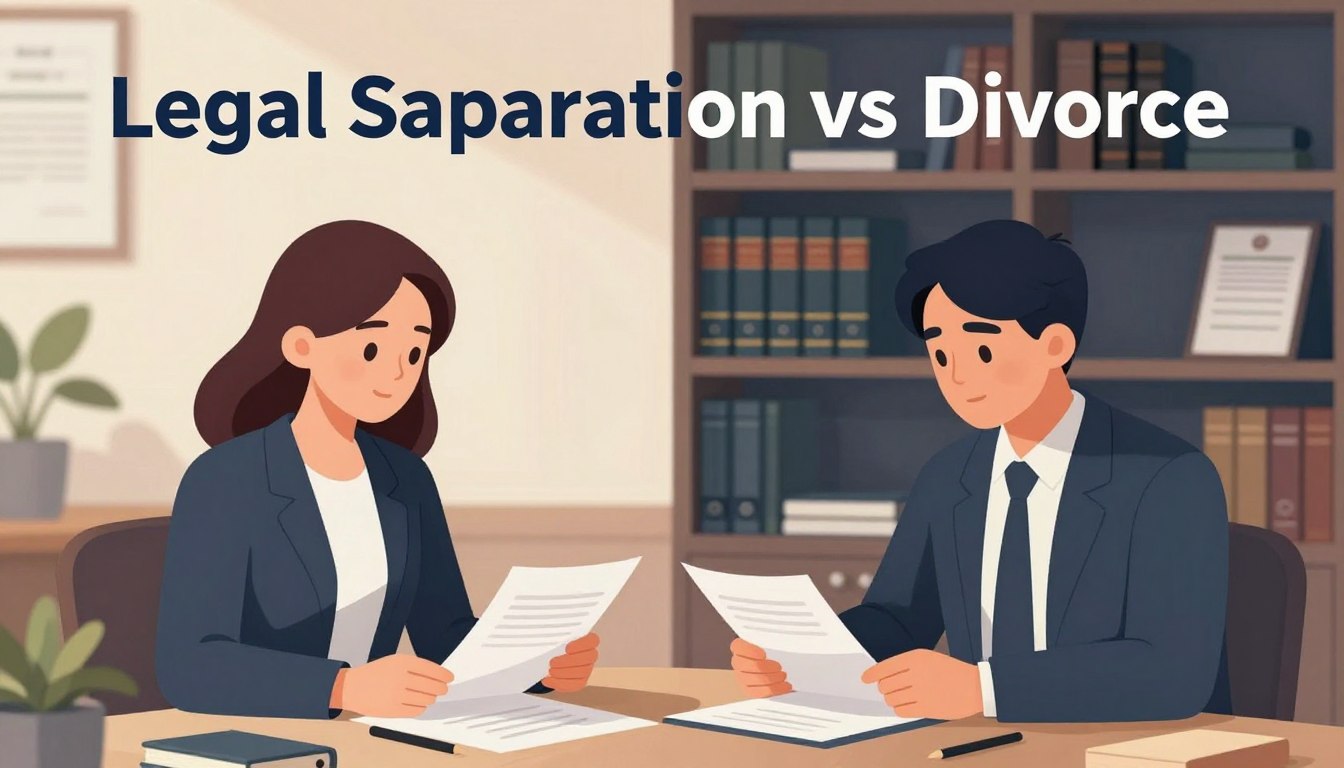
    A visually striking comparison scene illustrating "Legal Separation vs Divorce." In the foreground, depict two balanced scales, one labeled "Legal Separation" with a family home and supportive documents, and the other labeled "Divorce" displaying a court hammer and legal papers. In the middle ground, show two serene figures in professional business attire, a woman and a man, looking thoughtfully at each scale. They should be positioned on either side, representing the opposing choices with expressions of contemplation. The background features a split image: the left side portraying a calm, cozy home environment in soft natural light, while the right displays a stark, formal legal office setting with focused lighting. The mood is reflective and impartial, emphasizing clarity and decision-making in personal legal matters.

    Property Division Considerations

    Both legal separation and divorce involve the division of property, but the specifics can vary. In a legal separation, the division may be more flexible, whereas in a divorce, the division is typically more formal and final.

    Legal Rights and Responsibilities

    The legal rights and responsibilities of spouses also differ between legal separation and divorce. For instance, in a legal separation, spouses may still have a duty to support each other, whereas in a divorce, this obligation is typically terminated.

    Aspect Legal Separation Divorce
    Marital Status Remains married Marriage terminated
    Financial Benefits May retain benefits Typically loses benefits
    Property Division Flexible division Formal and final division
    Legal Rights and Responsibilities Duty to support may remain Support obligation typically ends

    The Process of Legal Separation

    Legal separation can be a complex process, but knowing the steps involved can make it more manageable. It is a legal status that allows couples to separate while still being married.

    Filing Requirements and Documentation

    To initiate legal separation, couples must file a petition with the court. The required documentation typically includes financial statements, property division agreements, and arrangements for child custody and support.

    State-Specific Legal Separation Laws

    Legal separation laws vary by state, with some states having specific requirements or restrictions. For example, some states require a waiting period before the separation can be finalized.

    Timeline and Procedures

    The timeline for legal separation can vary depending on the complexity of the case and the state’s laws. Generally, the process involves filing, serving the other party, and attending court hearings.

    State Waiting Period Required Documentation
    California 6 months Financial statements, property division agreements
    New York 1 year Separation agreement, financial disclosure
    Texas 60 days Petition for legal separation, financial information

    The Divorce Process in the United States

    The divorce process in the United States involves several legal steps and considerations. It is essential to understand the requirements and procedures to navigate this complex process effectively.

    Filing for Divorce: Required Documentation

    To initiate divorce proceedings, couples must file a petition with the court, typically requiring documentation such as financial records, identification, and sometimes proof of residency. The specific documents needed can vary by state.

    Contested vs. Uncontested Divorce

    A contested divorce occurs when spouses disagree on terms such as property division or child custody, often requiring court intervention. In contrast, an uncontested divorce means both parties agree on all terms, streamlining the process.

    A serene office setting depicting the divorce process in the United States. In the foreground, a professional woman in modest business attire sits at a desk with a laptop and legal documents, looking thoughtfully at a family photo. In the middle, a blurred image of a diverse group of individuals (a man and a woman in business casual attire) is discussing amicably at a separate table, signaling collaboration. The background features a window with soft natural light streaming in, suggesting a calm atmosphere. Use a slightly shallow depth of field to highlight the foreground while keeping the middle figures recognizable. The overall mood should be reflective and hopeful, emphasizing a constructive approach to the divorce process.

    No-Fault vs. Fault-Based Divorce

    No-fault divorce is granted without placing blame, typically citing irreconcilable differences. Fault-based divorce, however, requires proving wrongdoing such as adultery or abandonment.

    Typical Timeline and Costs

    The duration and cost of a divorce vary significantly based on factors like the complexity of the case and whether it is contested. On average, divorces can take several months to over a year and cost anywhere from a few thousand to tens of thousands of dollars.

    Understanding these aspects of the divorce process can help individuals better prepare for the legal and financial implications of their decision.

    Child Custody and Support Considerations

    The welfare of children is a paramount concern during legal separation and divorce proceedings. Parents must navigate complex decisions that impact their children’s lives, making it essential to understand the custody and support arrangements in both legal separation and divorce.

    Custody Arrangements in Legal Separation

    In legal separation, parents can establish custody arrangements that allow them to continue raising their children while maintaining separate households. This can involve joint custody, where both parents share decision-making responsibilities, or sole custody, where one parent has primary responsibility.

    Custody Arrangements in Divorce

    During divorce proceedings, custody arrangements are also determined, with the court’s primary consideration being the best interests of the child. Similar to legal separation, divorce custody arrangements can include joint or sole custody, with the goal of providing a stable environment for the children.

    Child Support Guidelines

    Child support is another critical aspect, ensuring that both parents contribute financially to their children’s upbringing. Guidelines for child support vary by state but generally consider factors such as income levels, the number of children, and custody arrangements to determine fair support amounts.

    Factor Legal Separation Divorce
    Custody Type Joint or Sole Custody Joint or Sole Custody
    Child Support Basis Income, Expenses Income, Expenses, Custody

    Understanding these considerations can help parents make informed decisions that prioritize their children’s welfare during these challenging processes.

    Pros and Cons of Each Option

    The choice between legal separation and divorce is a significant one, with each option having its own set of advantages and disadvantages. Couples must carefully consider these factors to make an informed decision that suits their individual circumstances.

    Advantages of Legal Separation

    Legal separation offers several benefits, including the ability to maintain certain marital benefits such as health insurance and social security benefits. It also allows couples to separate their lives while still being legally married, which can be important for religious or personal reasons.

    • Retains marital benefits
    • Preserves religious or personal values
    • Allows for reconciliation

    Disadvantages of Legal Separation

    Despite its advantages, legal separation also has its drawbacks. It can be costly and time-consuming, similar to divorce. Additionally, it may not provide the same level of finality as divorce, potentially leading to future conflicts.

    • Costly and time-consuming
    • Lack of finality
    • Potential for future conflicts

    Advantages of Divorce

    Divorce provides a clean break, allowing both parties to move on with their lives. It also offers the opportunity to remarry and start anew. Furthermore, divorce can be a more straightforward process than legal separation in some jurisdictions.

    • Provides a clean break
    • Allows for remarriage
    • Can be a straightforward process

    Disadvantages of Divorce

    However, divorce also has its downsides. It can be emotionally challenging, and the process can be complex and contentious, especially regarding property division and child custody. Additionally, divorce may result in the loss of certain marital benefits.

    • Emotionally challenging
    • Complex and contentious process
    • Potential loss of marital benefits
    Considerations Legal Separation Divorce
    Marital Benefits Retains benefits May lose benefits
    Finality Lack of finality Provides finality
    Remarriage Not allowed Allowed

    A visually engaging split-image comparison illustrating "Legal Separation vs Divorce." In the foreground, on one side, depict a calm, serene living room showcasing two individuals in professional business attire, sitting at a table discussing their legal separation amicably, with documents and a cup of tea between them. On the other side, show a contrasting scene of a tense law office meeting, where a couple is discussing divorce proceedings, with a lawyer present and papers scattered on the desk, highlighting the emotional weight of the situation. The middle layer transitions smoothly with symbolic elements like a dividing line or a scale balanced between peace and conflict. The background features soft, warm lighting on the separation side, while the divorce side has a cooler, harsher light to emphasize stress. Warm color tones evoke hope and calmness, while cooler tones illustrate tension and uncertainty.

    How to Decide Between Legal Separation and Divorce

    Deciding between legal separation and divorce is a complex decision that involves various personal, financial, and legal considerations. Couples must carefully evaluate their circumstances and priorities to make an informed choice.

    Personal and Religious Considerations

    For many individuals, personal beliefs and religious affiliations play a significant role in the decision-making process. Some religions discourage divorce, making legal separation a more viable option. It’s essential to consider how these factors influence your decision.

    Financial and Insurance Considerations

    Financial implications are a crucial aspect of deciding between legal separation and divorce. Considerations include:

    • Division of assets and liabilities
    • Insurance coverage, including health, life, and disability insurance
    • Tax implications and potential benefits or drawbacks of filing jointly or separately

    Understanding these financial aspects can significantly impact your decision.

    Legal Considerations

    Legal considerations involve understanding the laws in your state regarding both legal separation and divorce. This includes:

    1. Residency requirements
    2. Grounds for divorce or legal separation
    3. Property division laws

    Consulting with a legal professional can provide clarity on these matters.

    Transitioning from Separation to Divorce

    For some couples, legal separation is a step towards divorce. Understanding the process of transitioning from legal separation to divorce is vital, including the potential need to refile or modify existing agreements.

    By carefully considering these factors, couples can make a more informed decision that aligns with their personal, financial, and legal circumstances.

    Conclusion: Making an Informed Decision

    Understanding the differences between legal separation and divorce is crucial for making an informed decision that suits your personal, financial, and legal circumstances. The choice between these two options depends on various factors, including your marital status, financial implications, property division, and legal rights and responsibilities.

    Legal separation vs divorce explained in detail throughout this guide highlights the benefits and drawbacks of each option. While legal separation allows couples to separate their lives without officially ending the marriage, divorce provides a more permanent solution. Weighing the legal separation vs divorce benefits is essential to determine which path is best for you.

    Ultimately, the decision to pursue legal separation or divorce should be based on careful consideration of your individual circumstances and priorities. By understanding the key differences and implications of each option, you can make a confident choice that aligns with your needs and goals.

    FAQ

    What is the main difference between legal separation and divorce?

    The primary difference is that legal separation allows couples to remain married while living apart, whereas divorce terminates the marriage.

    How does legal separation affect my marital status?

    In a legal separation, you are still considered married in the eyes of the law, whereas in a divorce, your marital status changes to single.

    Can I still receive my spouse’s health insurance benefits if we are legally separated?

    It depends on the insurance provider and the specific policy. Some insurance companies allow legally separated spouses to remain on the same policy, while others may not.

    How is property divided in a legal separation versus a divorce?

    In both cases, property division is typically determined by the court or through a mutual agreement. However, the specifics can vary depending on state laws and individual circumstances.

    Can I remarry if I am legally separated?

    No, you cannot remarry if you are legally separated, as you are still considered married. To remarry, you would need to obtain a divorce.

    What are the advantages of choosing legal separation over divorce?

    Some benefits of legal separation include maintaining certain benefits, such as health insurance, and potentially preserving a relationship with your spouse for the sake of children or other reasons.

    How long does the legal separation process typically take?

    The duration of the legal separation process varies depending on state laws, court schedules, and the complexity of the case. It can take anywhere from a few months to a year or more.

    Can I convert a legal separation to a divorce?

    Yes, in many cases, you can transition from a legal separation to a divorce. The process typically involves filing additional paperwork with the court.

    What are the key factors to consider when deciding between legal separation and divorce?

    When making your decision, consider personal, financial, and legal factors, including your reasons for separating, the impact on children, and the potential effects on your financial situation.

    Are there any tax implications I should be aware of when choosing between legal separation and divorce?

    Yes, both legal separation and divorce can have tax implications, such as changes to your filing status and potential impacts on deductions and credits. It’s essential to consult with a tax professional to understand your specific situation.
  • The Formula for Calculating Child Support Payments

    The Formula for Calculating Child Support Payments

    Have you ever wondered what determines the amount of financial assistance one parent must provide to the other for their children’s well-being after a divorce or separation? The answer lies in understanding the child support guidelines that courts use to ensure fairness.

    The process of determining child support payments involves a complex formula that varies by state but generally considers the income of both parents and the number of children involved.

    Understanding this formula is crucial for parents navigating a divorce or separation, as it significantly impacts their financial responsibilities.

    Key Takeaways

    • The formula for calculating child support payments varies by state.
    • Courts consider the income of both parents when determining child support.
    • The number of children is a significant factor in child support calculations.
    • Understanding child support guidelines is essential for parents going through a divorce or separation.
    • The goal of child support calculations is to ensure fairness and the well-being of the children.

    Understanding Child Support Basics

    The concept of child support is rooted in the principle that both parents are responsible for the financial well-being of their children. This principle is fundamental in family law, ensuring that children receive the support they need from both parents, even if they are no longer together.

    Purpose of Child Support

    Child support is designed to cover the basic needs of children, including food, clothing, education, and healthcare. As Judge David L. Bazelon once said,

    “The child’s best interest is not served by allowing the non-resident parent to abandon their financial responsibilities.”

    This emphasizes the importance of both parents contributing financially.

    Legal Obligation to Pay

    The legal obligation to pay child support is typically determined during divorce or separation proceedings. Parents are required to provide financial support, and failure to do so can result in legal consequences.

    Federal Guidelines vs. State Variations

    While federal guidelines provide a general framework for child support, individual states have their own methods for calculating child support. This means that the specific rules and calculations can vary significantly from one state to another. For instance, some states use the Income Shares Model, while others might use different models. Understanding these variations is crucial for parents to navigate their obligations effectively.

    How Child Support Is Calculated: The Core Formula

    Understanding how child support is calculated requires a look into the different models used by states, each with its own methodology. The calculation of child support is a critical aspect of family law, ensuring that children receive the financial support they need from both parents.

    Income Shares Model

    The Income Shares Model is one of the most widely used methods for calculating child support. This model takes into account the combined income of both parents and allocates child support based on the proportion of each parent’s income to their total combined income. The idea is to ensure that the child receives the same proportion of parental income as they would have if the parents were living together.

    A key feature of the Income Shares Model is its consideration of both parents’ incomes, providing a more balanced approach to child support calculations. For instance, if one parent earns 60% of the combined income, they would be responsible for 60% of the child support.

    Percentage of Income Model

    The Percentage of Income Model is another common method used for calculating child support. This model calculates child support based on a percentage of the non-custodial parent’s income. The percentage can vary depending on the number of children and other factors. For example, a state might require 20% of the non-custodial parent’s income for one child.

    This model is straightforward but does not take into account the income of the custodial parent, which can be a limitation. However, it is simple to apply and can be effective in many cases.

    Melson Formula

    The Melson Formula is a more complex method used primarily in Delaware. It involves a detailed calculation that first determines the primary support needs of the child, then adjusts for the income of both parents. This formula is designed to ensure that both parents contribute fairly to the support of their children.

    “The Melson Formula is notable for its detailed approach, taking into account various expenses and income levels to arrive at a fair child support amount.”

    State-by-State Differences

    It’s crucial to understand that child support calculations can vary significantly from one state to another. While some states use the Income Shares Model, others might use the Percentage of Income Model or a variation of these. For example, Delaware uses the Melson Formula, which is unique to that state.

    A visually engaging child support calculator scene, featuring a sleek, modern calculator prominently displayed in the foreground with numeric buttons and a digital screen showing calculations. In the middle layer, depict a professional workspace with a desktop adorned with neatly organized documents, financial statements, and a notepad with handwritten notes on child support formulas. The background should subtly suggest a cozy and well-lit office environment, perhaps with a window allowing natural light to stream in, casting soft shadows. The atmosphere should feel focused and calm, suitable for concentration on important financial calculations. Capture the mood with warm lighting, using a soft focus on the background to emphasize the calculator and documents in the foreground. Ensure all elements maintain a professional appearance, reflecting seriousness and clarity in financial matters.

    When calculating child support, it’s essential to consult the specific guidelines for your state, as they can affect the final child support amount. Using a child support calculator can help estimate payments, but the actual calculation may vary based on state laws and individual circumstances.

    Determining Income for Child Support Calculations

    Income determination is a pivotal aspect of child support calculations, influencing the financial responsibilities of both parents. Accurately assessing the income of both parents is crucial for a fair child support arrangement, especially in shared custody situations.

    What Counts as Income

    For child support purposes, income encompasses a broad range of earnings, including wages, salaries, bonuses, commissions, and other forms of compensation. It’s not just the regular salary that counts; other income sources like investments, rental properties, and even certain benefits can be included in the calculation.

    Self-Employment Considerations

    Self-employed individuals present a unique challenge in child support calculations. Their income can fluctuate, and business expenses can affect their actual earnings. To accurately determine their income, courts often look at historical earnings, business financial statements, and tax returns.

    Imputed Income for Unemployed Parents

    In cases where a parent is unemployed or underemployed, the court may impute income based on their potential earning capacity. This ensures that the child support calculation is fair and reflects the parent’s ability to earn, rather than their current unemployment status.

    Income Verification Process

    Verifying income is a critical step in the child support calculation process. This involves reviewing pay stubs, tax returns, and other financial documents to ensure accuracy. For self-employed individuals, this may also include reviewing business financial records.

    Tax Implications and Deductions

    Tax implications can significantly affect child support calculations. Understanding how deductions and tax credits impact a parent’s net income is crucial. For instance, certain deductions can reduce taxable income, potentially lowering the child support amount.

    Understanding the intricacies of income determination is vital for parents navigating child support arrangements, particularly those with shared custody or complex financial situations. By accurately assessing income and considering all relevant factors, parents can work towards a fair and equitable child support agreement that supports their child’s well-being.

    Factors That Modify the Basic Calculation

    Child support calculations are not one-size-fits-all; several factors can adjust the basic amount to better suit the needs of the child. While the basic child support formula provides a foundational amount, various elements can significantly alter the final calculation to ensure it is fair and equitable for both parents and meets the child’s needs.

    Number of Children

    The number of children is a significant factor that can modify the basic child support calculation. Generally, the more children there are, the higher the support amount will be, although the amount per child may decrease with additional children.

    Healthcare and Insurance Costs

    Healthcare and insurance costs are another crucial factor. The cost of health insurance premiums for the children, as well as any out-of-pocket medical expenses, can be factored into the child support calculation.

    A visually engaging illustration representing "child support modification factors." In the foreground, depict a diverse group of professionals in business attire seated around a conference table, analyzing charts and documents related to calculations. In the middle ground, show detailed paperwork and calculators, emphasizing financial figures and graphs. In the background, have a large window with natural light streaming in, illuminating the space and creating a bright, focused atmosphere. Use a shallow depth of field to slightly blur the background while keeping the foreground in sharp detail. The overall mood should convey a sense of collaboration, professionalism, and seriousness, reflecting the important considerations involved in modifying child support calculations.

    Educational Expenses

    Educational expenses, including private school tuition or extracurricular activities, can also impact the child support amount. Courts may consider these expenses when determining the final child support payment.

    Childcare Costs

    Childcare costs, necessary for the custodial parent to work or attend education/training, are another factor that can modify the basic calculation.

    Factor Description Impact on Child Support
    Number of Children Increases with more children Higher total support amount
    Healthcare Costs Includes insurance premiums and out-of-pocket expenses Can increase support amount
    Educational Expenses Private school, extracurricular activities May increase support amount

    Special Needs Considerations

    Children with special needs may require additional financial support for medical care, therapy, or special education. These costs can significantly impact the child support calculation.

    Extraordinary Expenses

    Extraordinary expenses, such as travel for visitation or special activities, can also be considered when calculating child support.

    Understanding these factors is crucial for parents to anticipate their child support obligations and ensure that the final calculation is fair and in the best interest of the child.

    Custody Arrangements and Their Impact on Support

    Understanding the impact of various custody arrangements on child support is essential for parents navigating the complexities of family law. Custody arrangements play a pivotal role in determining child support payments, as they directly influence the financial responsibilities of each parent.

    Sole Custody Calculations

    In sole custody arrangements, one parent has primary custody of the child, and the other parent is typically required to pay child support. The calculation of child support in such cases is relatively straightforward, focusing on the non-custodial parent’s income and the custodial parent’s financial needs. TheIncome Shares Modelis commonly used, where both parents’ incomes are considered to determine the child support amount.

    For instance, if the non-custodial parent earns 60% of the total parental income, they might be required to pay 60% of the total child support obligation.

    Joint or Shared Custody Adjustments

    In joint or shared custody arrangements, both parents share custody of the child, which can complicate child support calculations. The court considers the amount of time each parent spends with the child and their respective incomes.Parenting time creditsmay be applied to adjust the child support amount based on the percentage of time each parent cares for the child.

    A table illustrating how shared custody affects child support calculations is shown below:

    Custody Arrangement Parenting Time Child Support Adjustment
    Sole Custody Less than 30% No adjustment
    Joint Custody 30% to 50% Reduction based on parenting time
    Shared Custody More than 50% Significant adjustment based on income and time

    Split Custody Situations

    In split custody situations, there are multiple children, and each parent has custody of at least one child. Child support calculations in these cases involve determining the financial responsibilities for each child and then offsetting the amounts to determine the net child support payment.

    Parenting Time Credits

    Parenting time credits are adjustments made to child support calculations based on the amount of time each parent spends with the child. These credits recognize the financial responsibilities incurred by the non-custodial parent during their parenting time.

    Using Child Support Calculators for Different Custody Scenarios

    Child support calculators can be invaluable tools for parents trying to estimate their child support obligations under different custody arrangements. By inputting their incomes, the number of children, and the proposed custody arrangement, parents can get an estimate of their potential child support payments.

    By understanding how different custody arrangements impact child support, parents can better navigate the legal system and plan their financial futures.

    Conclusion: Navigating Child Support Calculations

    Navigating child support calculations can be complex, but understanding the factors and formulas involved is crucial for ensuring that children’s financial needs are met. By grasping the basics of child support guidelines and using a child support calculator, parents can better estimate the amount of support required.

    It’s essential to consider the various elements that influence child support calculations, including income, custody arrangements, and additional expenses. Consulting with legal professionals and utilizing child support calculators can help parents determine a fair and accurate amount of support based on their specific circumstances.

    By being informed and proactive, parents can work together to ensure their children’s financial well-being. Using child support guidelines and calculators effectively can simplify the process, allowing parents to focus on what’s most important – the welfare of their children.

    FAQ

    How is child support calculated?

    Child support is typically calculated using a formula that considers the income of both parents, the number of children, and other relevant factors. The specific formula used varies by state, with some using the Income Shares Model, Percentage of Income Model, or Melson Formula.

    What counts as income for child support calculations?

    Income for child support calculations includes wages, bonuses, and other forms of earnings. Self-employment income, investments, and other sources of revenue may also be considered. The income verification process is used to determine the actual income of both parents.

    How do custody arrangements affect child support?

    Custody arrangements, such as sole custody, joint or shared custody, and split custody, can impact child support calculations. Parenting time credits may be applied in joint or shared custody situations, affecting the final child support amount.

    Can child support be modified?

    Yes, child support can be modified if there is a significant change in circumstances, such as a change in income, employment status, or custody arrangement. The modification process typically involves recalculating child support using the current formula and circumstances.

    How do I determine the correct child support amount for my situation?

    To determine the correct child support amount, you can use a child support calculator or consult with a legal professional. They can help you navigate the specific guidelines and formulas used in your state and consider factors unique to your situation.

    What factors can modify the basic child support calculation?

    Factors such as the number of children, healthcare and insurance costs, educational expenses, childcare costs, special needs considerations, and extraordinary expenses can modify the basic child support calculation.

    Are there different child support guidelines for shared custody?

    Yes, shared custody arrangements often involve adjustments to the basic child support calculation. Parenting time credits and other factors may be considered when determining child support in shared custody situations.

    How do I verify income for child support purposes?

    Income verification typically involves providing financial documents, such as pay stubs, tax returns, and other records of income. The income verification process helps ensure that child support calculations are based on accurate and up-to-date information.
  • Navigating Child Custody Laws: Tips for Parents

    Navigating Child Custody Laws: Tips for Parents

    Are you aware of your rights and responsibilities when it comes to making decisions about your child’s future during a custody dispute?

    Navigating the complex world of custody laws can be daunting, but being informed is key to ensuring the best outcome. Understanding the legal framework and knowing how to navigate custody orders is crucial.

    By being prepared and making informed decisions, you can better navigate the process and ensure your child’s needs are met.

    Key Takeaways

    • Understand your rights and responsibilities in a custody dispute.
    • Know the legal framework surrounding custody laws.
    • Learn how to navigate custody orders effectively.
    • Be prepared to make informed decisions for your child’s future.
    • Ensure your child’s needs are prioritized throughout the process.

    Understanding Child Custody Laws for Parents

    Understanding child custody laws is essential for parents to secure their parental rights and ensure the best outcome for their child. Child custody laws govern the legal relationship between a parent and their child, determining the rights and responsibilities of each parent.

    Custody arrangements can vary significantly depending on the jurisdiction and the specific circumstances of the case. It is crucial for parents to understand the different types of custody arrangements available.

    Different Types of Custody Arrangements

    Custody can be categorized into different types, including sole custody, where one parent has exclusive custody, and joint custody, where both parents share custody. Within these categories, there are further distinctions, such as joint legal custody and joint physical custody.

    Type of Custody Description
    Sole Custody One parent has exclusive legal and physical custody.
    Joint Legal Custody Both parents share decision-making responsibilities.
    Joint Physical Custody Both parents share physical care of the child.

    Legal Custody vs. Physical Custody

    Legal custody refers to the right to make important decisions about a child’s life, including education, healthcare, and religious upbringing. Physical custody, on the other hand, refers to the physical living arrangements of the child. Understanding the distinction between legal and physical custody is vital for parents to navigate custody disputes effectively.

    The “Best Interests of the Child” Standard

    Courts use the “best interests of the child” standard to determine custody arrangements. This standard considers various factors, including the child’s physical and emotional needs, the parents’ ability to provide a stable environment, and the child’s relationship with each parent.

    State Variations in Custody Laws

    Child custody laws vary significantly from state to state. Some states have specific statutes governing custody determinations, while others rely on case law. Parents must familiarize themselves with the specific laws in their jurisdiction to navigate the custody process effectively.

    Preparing for Your Child Custody Case

    When facing a child custody dispute, it’s crucial to be well-prepared to ensure the best possible outcome for all parties involved. Child custody cases can be emotionally challenging and legally complex, making preparation key to navigating the process successfully.

    A focused scene illustrating a child custody preparation meeting in a well-lit, contemporary office. In the foreground, a diverse group of three professionals, including a lawyer in business attire, a counselor in professional clothing, and a concerned parent in smart casual wear, sit around a conference table covered with documents, a notepad, and a laptop. In the middle ground, a window shows soft natural light streaming in, illuminating the room and creating an atmosphere of seriousness yet optimism. The background features bookshelves filled with legal books, family photos, and certificates, representing expertise and support. The mood is collaborative and supportive, with expressions reflecting determination and hope as they strategize for the custody case, embodying the essence of preparation and guidance.

    Essential Documentation to Gather

    Gathering essential documentation is a critical step in preparing for a child custody case. This includes financial records, communication logs with the other parent, and records of your involvement in your child’s life, such as school and medical records. Organizing these documents will help your attorney build a strong case on your behalf.

    Finding the Right Family Law Attorney

    Finding an experienced family law attorney who specializes in child custody cases is vital. Look for an attorney with a proven track record in handling custody disputes. They can provide valuable guidance on custody battle laws and help you understand your rights and options. A good attorney will also help you prepare for negotiations and court proceedings.

    Self-Representation Options and Resources

    While it’s recommended to have legal representation, some parents may choose to represent themselves. If this is the case, there are resources available to help, such as court-provided self-help services and online legal forms. However, it’s essential to understand that self-representation can be challenging, especially in complex custody cases.

    Creating a Parenting Plan Proposal

    A well-crafted parenting plan is crucial in child custody cases. This plan should outline how you and the other parent will share responsibilities and make decisions for your child. Consider including details on custody arrangements, visitation schedules, and decision-making processes. A comprehensive plan demonstrates your commitment to your child’s well-being and can be a valuable tool in negotiations.

    By being thoroughly prepared, gathering necessary documentation, finding the right legal representation, and creating a detailed parenting plan, you can significantly improve your chances of a favorable outcome in your child custody case.

    Navigating the Court Process

    For parents facing child custody disputes, understanding the intricacies of the court process is essential. The court’s primary concern is the best interests of the child, and navigating this process requires a comprehensive understanding of the legal framework and procedures involved.

    Filing and Temporary Orders

    The court process begins with the initial filing, where one parent submits a petition for custody. This is followed by the court issuing temporary orders, which dictate the custody arrangement until a final decision is made. It’s crucial for parents to understand that these temporary orders can set the tone for the subsequent custody arrangement.

    • Prepare all necessary documentation to support your custody case.
    • Understand the court’s criteria for determining temporary custody.
    • Be prepared to negotiate or litigate the terms of temporary orders.

    Mediation and Negotiation Strategies

    Mediation is a critical step in the custody process, allowing parents to negotiate a custody arrangement with the help of a neutral third-party mediator. Effective negotiation strategies can lead to a more amicable agreement, reducing the stress on all parties involved, especially the children.

    Some key negotiation strategies include:

    1. Focusing on the best interests of the child.
    2. Being open to compromise.
    3. Maintaining a respectful and cooperative demeanor.

    Custody Hearings

    During custody hearings, both parents have the opportunity to present their case to the court. It’s essential to be thoroughly prepared, with all relevant evidence and witnesses ready to support your custody proposal.

    Special Circumstances

    Some custody cases involve special circumstances, such as allegations of abuse or neglect. In these situations, the court’s primary concern remains the safety and well-being of the child. Parents must be aware of how to navigate these complex issues within the court process.

    Understanding co-parenting rights and joint custody laws can also play a significant role in how these cases are handled, emphasizing the need for parents to be informed and prepared.

    Co-Parenting After Custody Decisions

    Once the court has made its custody decision, the real work of co-parenting begins. Co-parenting after a custody decision requires a new level of cooperation and communication between both parents to ensure the well-being of their child.

    Implementing Custody Agreements Effectively

    To implement custody agreements effectively, parents should create a detailed parenting plan that outlines the specifics of their co-parenting arrangement. This plan should include schedules for visitation, holidays, and vacations, as well as guidelines for making decisions about the child’s education, healthcare, and extracurricular activities.

    • Establish a regular communication schedule with your co-parent.
    • Use a shared calendar to keep track of appointments and events.
    • Be flexible and willing to adjust the plan as needed.

    Communication Strategies with Your Co-Parent

    Effective communication is crucial for successful co-parenting. Parents should use clear and respectful language when communicating with each other, avoiding confrontational or aggressive tone. It’s also helpful to establish a primary mode of communication, such as email or a co-parenting app, to keep records of conversations.

    1. Schedule regular check-ins to discuss the child’s progress.
    2. Use “I” statements instead of “you” statements to avoid blame.
    3. Keep conversations focused on the child’s needs.

    A warm, inviting scene in a bright, modern office setting, where two parents are sitting at a round table, engaged in a constructive discussion. The foreground features the parents, a man and a woman, both in professional business attire, actively exchanging ideas and reviewing documents related to their child's upbringing. The middle ground includes a laptop and a few colorful folders with child custody plans visible. In the background, a large window lets in soft, natural light, showcasing a peaceful view of a park with children playing, symbolizing hope and collaboration. The mood is positive and cooperative, emphasizing a sense of teamwork and mutual respect in co-parenting. The image should be bright and well-lit, captured from a slightly elevated angle to create an engaging perspective.

    Handling Custody Modifications

    Circumstances can change over time, and parents may need to modify their custody agreement. To do this, they should document the changes in circumstances and negotiate with their co-parent to come to a new agreement. If an agreement can’t be reached, they may need to return to court.

    Addressing Custody Agreement Violations

    If a parent violates the custody agreement, the other parent should document the violation and attempt to resolve the issue through communication. If the issue persists, they may need to seek enforcement through the court, which can impose penalties on the violating parent.

    By working together and being proactive, parents can create a stable and loving environment for their child, even in the face of a custody dispute.

    Conclusion

    Successfully navigating child custody laws requires a comprehensive understanding of the legal framework and a willingness to cooperate. By following the guidance provided in this article, parents can better understand how to navigate child custody orders and protect their parental rights in child custody disputes.

    When determining child custody, the court’s primary concern is the best interests of the child. Parents should prioritize their child’s needs and work together to create a stable and loving environment. This may involve negotiating a mutually acceptable custody arrangement or seeking the assistance of a family law attorney to represent their interests.

    Effective co-parenting is crucial to a successful custody arrangement. Parents should strive to maintain open communication and cooperate in making decisions that benefit their child. By doing so, they can ensure that their child’s needs are met and that they are able to navigate the complexities of child custody laws with confidence.

    By understanding their rights and responsibilities, parents can navigate the complexities of child custody laws and make informed decisions about their child’s future. This knowledge will enable them to effectively navigate child custody orders and protect their parental rights in child custody disputes.

    FAQ

    What are the different types of child custody arrangements?

    There are several types of child custody arrangements, including sole custody, joint custody, and split custody. Sole custody means one parent has primary custody, while joint custody involves both parents sharing decision-making responsibilities. Split custody involves dividing the children between the two parents.

    How do courts determine child custody?

    Courts typically determine child custody based on the “best interests of the child” standard, considering factors such as the child’s physical and emotional needs, the parents’ ability to provide a stable environment, and any history of abuse or neglect.

    Can I modify an existing child custody agreement?

    Yes, child custody agreements can be modified if there is a significant change in circumstances, such as a change in a parent’s work schedule or a move to a new location. You will need to petition the court to modify the agreement.

    What is the difference between legal custody and physical custody?

    Legal custody refers to the right to make decisions about a child’s upbringing, education, and healthcare, while physical custody refers to the child’s living arrangements. A parent can have joint legal custody but sole physical custody, for example.

    How can I prepare for a child custody case?

    To prepare for a child custody case, gather essential documentation, such as financial records and communication with your child, and consider hiring a family law attorney to represent your interests. Creating a parenting plan proposal can also help demonstrate your commitment to your child’s well-being.

    What are my rights as a co-parent?

    As a co-parent, you have the right to participate in decision-making about your child’s upbringing, to spend time with your child according to the custody agreement, and to be informed about your child’s needs and well-being.

    Can I represent myself in a child custody case?

    While it is possible to represent yourself in a child custody case, it is generally recommended to hire a family law attorney who can provide guidance and representation throughout the process.

    How do I handle a custody agreement violation?

    If the other parent violates the custody agreement, you should document the incident and seek enforcement through the court. You may need to file a motion for contempt or seek a modification to the agreement.

    What are joint custody laws?

    Joint custody laws vary by state, but generally, they require both parents to share decision-making responsibilities and cooperate in making decisions about their child’s upbringing.

    How do I navigate child custody orders?

    To navigate child custody orders, understand the terms of the order, including the type of custody arrangement and any specific requirements or restrictions. You should also be prepared to communicate with your co-parent and seek enforcement if necessary.
  • Divorce Process Step-by-Step Explained

    Divorce Process Step-by-Step Explained

    Are you navigating the complex and often emotionally challenging experience of divorce? Understanding the divorce proceedings can help alleviate some of the uncertainty and stress.

    For those who are just starting out, knowing what to expect is crucial. The divorce journey involves several key stages, from filing the initial petition to the final settlement.

    As you embark on this journey, it’s essential to have a clear understanding of the steps involved. This guide will walk you through the divorce process, providing a comprehensive overview to help you navigate this challenging time.

    Key Takeaways

    • Understanding the divorce process can reduce stress and uncertainty.
    • The divorce journey involves several key stages, from filing to final settlement.
    • Having a clear understanding of the steps involved is crucial for navigating the process.
    • This guide provides a comprehensive overview of the divorce process.
    • Knowing what to expect can help alleviate some of the emotional challenges.

    Understanding the Divorce Process: What to Expect

    Navigating the divorce process can be complex, but understanding the steps involved can make it more manageable. The divorce process in the United States is not a one-size-fits-all procedure; it varies based on the type of divorce and the jurisdiction.

    Types of Divorce in the United States

    The United States recognizes different types of divorce, primarily categorized into contested and uncontested divorces, as well as no-fault and fault-based divorces.

    Contested vs. Uncontested Divorce

    In a contested divorce, the spouses disagree on one or more issues, requiring court intervention. An uncontested divorce occurs when both parties agree on all terms.

    No-Fault vs. Fault-Based Divorce

    No-fault divorce is granted without placing blame on either spouse, often due to irreconcilable differences. Fault-based divorce requires proving wrongdoing by one spouse.

    Timeline Expectations for Different Divorce Scenarios

    The duration of a divorce varies significantly based on several factors.

    Factors That Affect Divorce Duration

    • Complexity of assets
    • Level of contention between spouses
    • Court backlog

    State-Specific Waiting Periods

    Some states have mandatory waiting periods before a divorce can be finalized.

    Understanding these factors and the type of divorce you’re undergoing can help set realistic expectations for the divorce process.

    Pre-Filing Considerations and Preparation

    Before initiating the divorce process, it’s essential to prepare yourself financially and legally. Proper preparation can make a significant difference in navigating the complexities of divorce.

    Financial Documentation You’ll Need

    Gathering financial documents is a critical step in preparing for divorce. This includes creating an inventory of your assets and debts, as well as documenting your income and expenses.

    Asset and Debt Inventory

    Make a comprehensive list of your assets, including real estate, vehicles, bank accounts, investments, and retirement accounts. Similarly, document all debts, such as mortgages, loans, and credit card balances.

    • Real estate properties
    • Vehicles and other significant assets
    • Bank accounts and investments
    • Retirement accounts
    • Mortgages and loans
    • Credit card balances

    Income and Expense Documentation

    Document your income from all sources, including employment, investments, and any side businesses. Additionally, track your monthly expenses to understand your financial obligations.

    A professional couple sitting at a dining table, deeply engaged in a financial planning discussion, surrounded by paperwork, charts, and a laptop. The foreground features their focused expressions, showcasing determination and care as they navigate complex emotions. The middle ground includes scattered documents and folders labeled 'Assets', 'Expenses', and 'Legal Advice,' emphasising the preparation stage of divorce. The background shows a cozy, well-lit home office with natural light streaming through a window, setting a calm yet serious atmosphere. The color palette is neutral with warm tones, conveying both hope and resolution. The scene is captured with a slightly blurred depth of field to focus on the couple, using soft, natural lighting to enhance the mood of thoughtful consideration and planning.

    Child Custody Considerations

    If children are involved, creating a parenting plan is crucial. This plan should outline custody arrangements, visitation schedules, and decision-making responsibilities.

    Creating a Parenting Plan

    A well-crafted parenting plan can help minimize conflicts and ensure the well-being of your children. Consider their needs, your work schedules, and other relevant factors when creating this plan.

    Selecting the Right Divorce Attorney

    Choosing the right divorce attorney can significantly impact the outcome of your divorce. Look for an attorney with experience in family law and a track record of successful outcomes.

    Questions to Ask Potential Attorneys

    When consulting with potential attorneys, ask questions such as:

    1. What experience do you have with divorce cases?
    2. How will you communicate with me throughout the process?
    3. What are your fees, and how will they be structured?
    4. How will you help me achieve my goals in the divorce?

    Filing for Divorce: Initial Legal Steps

    The divorce process officially begins with the filing of a divorce petition, a crucial step that sets the legal proceedings in motion. This initial step involves several key components that are essential for understanding the divorce procedure breakdown.

    Completing and Filing Divorce Petition

    To start the divorce process, one must complete and file a divorce petition with the appropriate court. This document outlines the grounds for divorce and the relief sought, such as property division, child custody, and spousal support.

    Required Forms and Documentation

    The divorce petition is accompanied by various forms and documentation, including financial disclosures and identification documents. Ensuring that all required paperwork is accurately completed is vital for a smooth divorce steps detailed explanation.

    Filing Fees and Fee Waivers

    Filing a divorce petition also involves paying a filing fee, which varies by jurisdiction. In some cases, individuals may be eligible for a fee waiver if they meet certain income criteria.

    Serving Divorce Papers to Your Spouse

    After filing the divorce petition, the next step is serving the divorce papers to your spouse. This involves delivering the legal documents to the other party, notifying them of the divorce proceedings.

    Service Methods and Requirements

    Service can be achieved through various methods, including personal service, certified mail, or service by a third-party process server. The specific requirements for serving divorce papers depend on local laws and regulations.

    Temporary Orders and Emergency Provisions

    During the divorce process, temporary orders may be issued to address immediate concerns, such as child support, custody, and spousal support.

    Child Support and Custody

    Temporary orders regarding child support and custody are designed to provide stability for children during the divorce proceedings.

    Spousal Support and Property Use

    Temporary orders may also address spousal support and the use of marital property, ensuring that both parties have the necessary resources during the divorce process.

    Temporary Order Purpose Typical Provisions
    Child Support Financial support for children Monthly payment amount, payment schedule
    Child Custody Arrangements for child care Custody schedule, decision-making authority
    Spousal Support Financial support for spouse Monthly payment amount, duration

    Understanding these initial legal steps is crucial for navigating the divorce process effectively. By being informed about the required forms, service methods, and temporary orders, individuals can better prepare themselves for the divorce procedure breakdown.

    The Divorce Process Step by Step Explained: From Response to Discovery

    The divorce journey doesn’t end with filing the petition; it’s just the beginning, as both parties must respond and engage in the discovery process. Understanding the steps involved can make this complex process more manageable.

    Responding to a Divorce Petition

    When served with a divorce petition, the respondent must take action. The response is crucial as it acknowledges the petition and allows the respondent to state their position regarding the divorce and its terms.

    Answer and Counterclaim Options

    The respondent can file an answer to admit or deny the allegations made in the petition. They may also file a counterclaim, which is a legal claim against the petitioner.

    • The answer should address each allegation made in the divorce petition.
    • A counterclaim allows the respondent to seek specific relief or make demands.

    Default Judgments: What Happens If No Response

    If the respondent fails to respond within the specified timeframe, the court may grant a default judgment in favor of the petitioner. This means the divorce will be finalized based on the petitioner’s terms without the respondent’s input.

    The Discovery Phase: Exchanging Information

    During the discovery phase, both parties exchange information and evidence to prepare for the divorce settlement or trial.

    Interrogatories and Document Requests

    Interrogatories are written questions that must be answered under oath. Document requests require parties to produce relevant documents, such as financial records.

    Depositions and Their Purpose

    Depositions involve sworn testimony outside of court. They allow attorneys to gather information, assess witness credibility, and prepare for trial.

    A serene office setting illustrating the divorce process step-by-step. In the foreground, a diverse group of three professionals—two women and one man—are gathered around a large table covered with documents and a laptop. They wear smart casual business attire, showing focus and collaboration. In the middle, a whiteboard displays a flowchart outlining the key stages of the divorce process, such as 'Response', 'Discovery', and 'Negotiation', represented with clear icons. The background features shelves with law books and soft lighting that creates a calm atmosphere, highlighting the serious yet constructive nature of the process. The scene captures a mood of professionalism and support, emphasizing clarity and understanding amidst the complexities of divorce. The angle is slightly above eye-level, giving an inclusive view of the interaction.

    Financial Disclosures and Asset Division Planning

    Financial disclosures are critical for equitable asset division. Both parties must provide comprehensive financial information.

    Mandatory Financial Disclosures

    Mandatory financial disclosures require both parties to submit detailed financial statements, including income, expenses, assets, and debts.

    Valuation of Complex Assets

    Complex assets, such as businesses or investments, require professional valuation to ensure fair division.

    • Forensic accountants or appraisers may be hired to value complex assets.
    • Accurate valuation is crucial for a fair divorce settlement.

    Negotiation and Settlement Procedures

    The divorce process is complex, but with the right approach to negotiation and settlement, couples can achieve a more amicable resolution. Negotiation and settlement are critical steps that follow the initial filing and response in a divorce case.

    Mediation Process and Benefits

    Mediation is a form of alternative dispute resolution that allows couples to negotiate their divorce terms with the assistance of a neutral third-party mediator. This process can be less adversarial and less expensive than going to trial.

    What to Expect in Mediation Sessions

    In mediation sessions, couples work together with the mediator to identify issues, discuss options, and reach agreements on divorce terms, including property division, child custody, and spousal support. The mediator facilitates the conversation but does not make decisions for the couple.

    Preparing for Successful Mediation

    To prepare for mediation, couples should gather relevant financial documents, clarify their goals and priorities, and be open to compromise. Understanding the mediation process and being prepared can significantly enhance the likelihood of a successful outcome.

    Collaborative Divorce Options

    Collaborative divorce is another approach that involves a team of professionals, including lawyers, financial specialists, and mental health professionals, working together to help couples achieve a settlement without going to court.

    The Collaborative Team Approach

    The collaborative team approach brings together experts who support the couple in addressing various aspects of the divorce, from financial planning to child custody arrangements. This comprehensive support can lead to more sustainable agreements.

    Creating a Settlement Agreement

    A settlement agreement is a legally binding document that outlines the terms of the divorce, including property division, financial support, and custody arrangements. It’s essential to ensure that the agreement is comprehensive and fair.

    Key Components of a Comprehensive Agreement

    A comprehensive settlement agreement should cover all relevant aspects of the divorce, including:

    • Division of marital property and debts
    • Spousal support or alimony
    • Child custody and visitation rights
    • Child support

    Review Process Before Finalization

    Before finalizing the settlement agreement, it’s crucial to review it carefully, potentially with the assistance of legal counsel, to ensure that it accurately reflects the agreed-upon terms and is in the best interest of all parties involved.

    Going to Trial: When Settlement Isn’t Possible

    When a divorce case cannot be settled, it may proceed to trial, a process that can be complex and emotionally challenging. Understanding the steps involved can help prepare you for what’s ahead.

    Preparing for Divorce Court

    Preparation is key when going to trial. This involves gathering evidence and witnesses who can support your case. Evidence may include financial records, communication logs, and any other relevant documents.

    Gathering Evidence and Witnesses

    Identifying and preparing witnesses is crucial. Witnesses can provide testimony that supports your claims regarding asset division, custody, or other disputed matters.

    Trial Strategy Development

    Developing a trial strategy involves working closely with your attorney to understand the strengths and weaknesses of your case, anticipating the arguments your spouse may present, and preparing counterarguments.

    A tense courtroom scene depicting a divorce trial process. In the foreground, a judge in traditional robes presides over the case, looking serious and authoritative. To the left, a male attorney in a sharp navy suit is passionately presenting his arguments, while to the right, a female attorney in a professional black dress listens attentively, taking notes. In the middle ground, a couple sits at separate tables, both showing a mixture of anxiety and determination, with documents scattered around them. The background features shelves filled with law books and a large window allowing natural light to illuminate the room, creating a dramatic atmosphere. The angle captures the intensity of the moment, emphasizing the emotional weight of the trial.

    What Happens During a Divorce Trial

    During the trial, both parties will present their cases to the judge. This includes testimony and cross-examination, where each side questions the other and their witnesses.

    Testimony and Cross-Examination

    Testimony involves presenting your case, while cross-examination allows the opposing side to challenge your testimony and that of your witnesses.

    Judge’s Decision-Making Process

    After hearing both sides, the judge will make decisions on the outstanding issues, such as asset division and custody arrangements.

    Post-Trial Motions and Appeals

    If either party is dissatisfied with the outcome, they may file post-trial motions or appeals. Understanding the grounds for appeal and the process for filing is crucial.

    Grounds for Appeal

    Appeals can be filed if there were legal errors during the trial that affected the outcome.

    Modification Possibilities

    Even after a trial concludes, certain aspects of the divorce decree can be modified if circumstances change.

    Trial Stage Description
    Pre-Trial Preparation Gathering evidence, identifying witnesses, and developing a trial strategy.
    Trial Proceedings Presenting cases, testimony, and cross-examination.
    Post-Trial Filing motions or appeals, and potential modifications.

    Conclusion: Moving Forward After Divorce Finalization

    Now that you’ve navigated the divorce process step by step explained in this guide, you’re ready to start a new chapter in your life. The divorce process for beginners can be overwhelming, but understanding the steps involved can make a significant difference.

    After the divorce is finalized, it’s essential to focus on your emotional and practical well-being. Take time to reflect on your experiences and the lessons learned during this journey. This reflection will help you grow and prepare for the future.

    As you move forward, consider seeking support from friends, family, or a professional counselor. They can provide guidance and help you navigate any challenges that arise. Remember, the end of the divorce process marks a new beginning, and with the right mindset, you can build a fulfilling life.

    FAQ

    What is the first step in the divorce process?

    The first step is typically to consult with a divorce attorney to understand your rights and obligations, and to begin gathering financial documentation and other necessary information.

    How long does the divorce process take?

    The length of the divorce process varies depending on several factors, including the complexity of the case, the level of contention between spouses, and the court’s schedule. On average, it can take several months to a year or more to finalize a divorce.

    What is the difference between a contested and uncontested divorce?

    A contested divorce is one where the spouses disagree on one or more issues, such as property division or child custody, and may require a trial to resolve. An uncontested divorce is one where the spouses agree on all issues and can typically be finalized more quickly.

    What is the role of mediation in the divorce process?

    Mediation is a process where a neutral third-party facilitates negotiations between spouses to help them reach a mutually acceptable agreement on disputed issues. It can be a helpful way to resolve conflicts without going to trial.

    How is child custody determined?

    Child custody is typically determined based on the best interests of the child, considering factors such as the child’s relationship with each parent, the parents’ ability to cooperate, and the child’s physical and emotional needs.

    What is the discovery phase in a divorce?

    The discovery phase is a process where both spouses exchange information and documents, such as financial records and witness statements, to prepare for trial or negotiations.

    Can I get a divorce without a lawyer?

    While it is possible to represent yourself in a divorce, it is generally not recommended, as divorce laws and procedures can be complex, and a lawyer can provide valuable guidance and protection of your rights.

    How is property divided in a divorce?

    Property division varies by state, but in general, marital property is divided equitably, which may not necessarily mean equally. Separate property, such as gifts or inheritances, is typically not subject to division.

    What is a settlement agreement?

    A settlement agreement is a written contract between spouses that outlines the terms of the divorce, including property division, child custody, and spousal support.

    Can a divorce be appealed?

    Yes, a divorce can be appealed if one spouse believes the court made an error in its decision. The appeal process involves reviewing the trial court’s decision and may result in a new trial or modification of the original decision.
  • How the Criminal Court Process Works

    How the Criminal Court Process Works

    Have you ever wondered what happens when someone is accused of a crime? The journey from arrest to sentencing involves a complex network of institutions and processes that uphold the law and protect society.

    The criminal justice system is designed to maintain law and order, but its intricacies can be difficult to navigate. Understanding this system is essential for anyone involved in or affected by criminal court proceedings.

    By grasping how the system functions, individuals can better appreciate the roles of different institutions and processes involved.

    Key Takeaways

    • The criminal justice system is a complex network of institutions.
    • It involves various processes from arrest to sentencing.
    • Understanding the system is crucial for those navigating it.
    • The system is designed to uphold the law and protect society.
    • Different institutions play distinct roles in the process.

    The Arrest and Booking Process

    Understanding the arrest and booking process is crucial for navigating the criminal court procedure from arrest to sentencing. This initial stage is critical in setting the tone for the subsequent legal proceedings.

    What Constitutes a Lawful Arrest

    A lawful arrest occurs when a law enforcement officer has probable cause to believe that an individual has committed a crime. This means that the officer must have sufficient evidence or reasonable grounds to make the arrest.

    The Booking Procedure Explained

    During the booking procedure, the individual’s personal information is recorded, and they are typically fingerprinted and photographed. This process is a crucial step in creating a formal record of the arrest.

    Your Constitutional Rights During Arrest

    It is essential to understand one’s constitutional rights during an arrest, including the right to remain silent and the right to an attorney. These rights are fundamental in protecting the individual’s interests during the arrest and booking process.

    Miranda Rights in Practice

    The Miranda Rights, which are read to the individual during the arrest, inform them of their rights and the potential consequences of waiving them. Understanding these rights is vital in making informed decisions during the arrest and booking process.

    Rights During Arrest Description
    Right to Remain Silent The individual has the right to remain silent and not answer questions from law enforcement.
    Right to an Attorney The individual has the right to an attorney, and if they cannot afford one, an attorney will be appointed to them.

    Legal Representation in Criminal Cases

    The importance of legal representation in criminal proceedings cannot be overstated, as it directly impacts the defendant’s rights and potential outcomes. Effective legal representation ensures that the defendant’s rights are protected throughout the legal proceedings.

    Right to an Attorney

    The Sixth Amendment guarantees the right to an attorney for individuals facing criminal charges. This constitutional right is fundamental to ensuring a fair trial.

    Public Defenders vs. Private Attorneys

    Defendants have the option to be represented by either public defenders or private attorneys. Public defenders are appointed for those who cannot afford legal representation, while private attorneys are hired by the defendant.

    Criteria Public Defenders Private Attorneys
    Cost Free or low-cost Variable, often expensive
    Case Load Typically high Variable, generally lower than public defenders
    Personalization Less personalized More personalized attention

    When Legal Counsel Should Be Obtained

    It is crucial to obtain legal counsel as soon as possible after being charged with a crime. Early representation can significantly impact the outcome of court case steps.

    Attorney-Client Privilege

    Communications between the defendant and their attorney are protected under attorney-client privilege. This privilege is essential for ensuring that defendants can openly discuss their case with their legal representation.

    “The lawyer’s duty is to protect the client’s rights, not to judge the client’s guilt or innocence.” –

    American Bar Association

    A courtroom scene depicting the steps of legal representation in a criminal case. In the foreground, a confident lawyer in a tailored dark suit stands beside a concerned client, who is attentively listening. The middle ground showcases a judge seated at the bench, looking authoritative and focused, with a gavel at hand. The background includes rows of benches filled with spectators, and a large window letting in natural light, highlighting the solemn atmosphere. The lighting is warm yet professional, casting soft shadows. Camera angle set slightly from above, capturing the layout of the courtroom and emphasizing the lawyer-client dynamic. The overall mood is serious and respectful, reflecting the gravity of legal proceedings.

    Initial Appearances and Bail Hearings

    The initial appearance and bail hearing are pivotal moments in the criminal court process, setting the stage for the defendant’s journey through the judicial system. During this stage, the defendant is informed of the charges against them and their rights.

    First Court Appearance Timeline

    The first court appearance typically occurs within a short period after the arrest, usually 24 to 48 hours. This timeline can vary depending on the jurisdiction and the specific circumstances of the case.

    Understanding Bail Determinations

    Bail determinations are made based on several factors, including the severity of the crime, the defendant’s flight risk, and their ties to the community. The court aims to ensure that the defendant appears for future court dates.

    Options When You Can’t Afford Bail

    If the defendant cannot afford bail, they may be eligible for pretrial release conditions. These can include:

    • Electronic monitoring
    • Regular check-ins with a pretrial officer
    • Travel restrictions

    Pretrial Release Conditions

    Pretrial release conditions are designed to ensure the defendant’s appearance in court while allowing them to remain in the community. Compliance with these conditions is crucial to avoid additional legal complications.

    Understanding the implications of initial appearances and bail hearings can significantly impact the defendant’s experience and the outcome of the case. It’s essential for defendants to be aware of their rights and the legal processes involved.

    The Charging Process

    The charging process is a pivotal stage in the criminal court timeline, determining whether a case proceeds to trial. This stage is crucial as it involves the formal accusation of a crime, which can significantly impact the defendant’s future.

    Difference Between Complaints and Indictments

    A complaint is a sworn statement alleging that an individual has committed a crime, typically filed by a law enforcement officer or a prosecutor. On the other hand, an indictment is a formal charge issued by a grand jury after reviewing evidence presented by the prosecution.

    The Grand Jury Process

    The grand jury process involves a group of citizens who review evidence to determine whether there is probable cause to indict the defendant. This process is usually conducted in secret to protect the defendant’s reputation if the charges are not pursued.

    Preliminary Hearings Explained

    Preliminary hearings provide an opportunity for the court to assess the evidence against the defendant and determine whether to proceed with the case. During this hearing, the prosecution presents evidence, and the judge decides if there is enough evidence to bind the defendant over for trial.

    Possible Outcomes of Charging Decisions

    The possible outcomes of charging decisions include dismissal of the charges, reduction of the charges, or binding the defendant over for trial. The outcome depends on the strength of the evidence presented during the preliminary hearing or grand jury process.

    Outcome Description
    Dismissal Charges are dropped due to lack of evidence.
    Reduction Charges are reduced to a lesser offense.
    Binding Over Defendant is sent to trial based on sufficient evidence.

    A detailed illustration of a "criminal court timeline," showcasing the steps involved in the charging process. In the foreground, highlight a stylized timeline with clear markers representing key stages such as Initial Appearance, Preliminary Hearing, and Arraignment, using distinct icons for each step. In the middle ground, depict diverse professionals in business attire, like judges, lawyers, and defendants engaged in discussion around a courtroom table, emphasizing collaboration and seriousness. The background features a dramatic courtroom setting with tall windows letting in soft natural light, casting gentle shadows. Use a perspective angle that draws the viewer's eye along the timeline, creating depth. The overall mood should be one of tension and gravity, reflecting the importance of each stage in the criminal process. No text or overlays.

    Pre-Trial Procedures

    Pre-trial procedures play a crucial role in shaping the course of a criminal trial. These procedures are essential for ensuring that both the prosecution and defense are adequately prepared for the legal proceedings ahead.

    Discovery: Sharing Evidence Between Parties

    The discovery phase is a critical component of pre-trial procedures, allowing both sides to share evidence and witness information. This process helps to prevent surprises during the trial and promotes a more efficient trial process.

    Common Pre-Trial Motions

    Pre-trial motions are requests made by the prosecution or defense to the court, seeking specific actions or rulings. Common motions include requests to suppress evidence, dismiss charges, or change the venue of the trial.

    Examples of Pre-Trial Motions:

    • Motion to Suppress Evidence
    • Motion to Dismiss Charges
    • Motion for Change of Venue

    Plea Bargaining Negotiations

    Plea bargaining is a process where the prosecution and defense negotiate a mutually acceptable agreement, potentially avoiding the need for a trial. This can involve reducing charges or recommending a specific sentence.

    Pre-Trial Conferences and Hearings

    Pre-trial conferences and hearings facilitate communication between the parties and the court, ensuring that the case is properly prepared for trial. These meetings can help resolve outstanding issues and streamline the trial process.

    Pre-Trial Procedure Purpose Outcome
    Discovery Share evidence and witness information More efficient trial process
    Pre-Trial Motions Request specific court actions Potential exclusion of evidence or dismissal of charges
    Plea Bargaining Negotiate a mutually acceptable agreement Avoidance of trial

    How the Criminal Court Process Works During Trial

    The trial is the centerpiece of the criminal court process, where both sides present their arguments. It is a complex and structured process that involves several key steps.

    Jury Selection and Voir Dire

    The trial begins with jury selection, a process known as voir dire. During voir dire, potential jurors are questioned by both the prosecution and defense to determine their suitability to hear the case. The goal is to select an impartial jury that can fairly consider the evidence presented.

    Opening Statements by Both Sides

    Once the jury is selected, both sides deliver opening statements. These statements provide an overview of the case and outline the key evidence and arguments that will be presented during the trial. The prosecution typically goes first, followed by the defense.

    A bustling criminal courtroom scene during a trial, showcasing the judicial process. In the foreground, a judge in a formal black robe presides over the court, with a focused expression. The middle ground features a diverse group of jurors attentively listening, all dressed in business attire. A lawyer stands confidently at the podium, gesturing as they present their case, while the defendant sits calmly, dressed in a modest outfit, reflecting varying emotions. In the background, a gallery filled with observers watches the proceedings. Soft, warm lighting illuminates the room, accentuating the seriousness of the trial. The composition captures the tension and formality of a courtroom setting, evoking a sense of justice and order.

    Presentation of Evidence and Witnesses

    The core of the trial involves the presentation of evidence and witnesses. Both the prosecution and defense call witnesses to testify and present physical evidence to support their cases. This is a critical phase where the credibility of witnesses and the strength of the evidence are tested.

    Cross-Examination Strategies

    A crucial aspect of the trial is cross-examination. Lawyers for both sides question the opposing party’s witnesses to challenge their testimony and credibility. Effective cross-examination can significantly impact the jury’s perception of the evidence.

    Closing Arguments and Jury Instructions

    After all evidence has been presented, both sides deliver closing arguments. These arguments summarize the key points of the case and attempt to persuade the jury to adopt their perspective. The judge then provides jury instructions, guiding the jury on the law they must apply when deliberating.

    Trial Phase Description
    Jury Selection Selecting an impartial jury through voir dire
    Opening Statements Overview of the case by both sides
    Presentation of Evidence Presenting evidence and witnesses
    Cross-Examination Challenging the opposing party’s witnesses
    Closing Arguments Summarizing the case and persuading the jury

    As noted by legal expert Bryan Stevenson, “The true measure of our character is how we treat the poor, the accused, the incarcerated, and the condemned.” This highlights the importance of a fair trial process.

    Verdict and Sentencing Procedures

    After the trial concludes, the jury deliberates to reach a verdict, marking a critical juncture in the criminal court process. This stage is crucial as it determines the defendant’s guilt or innocence.

    How Juries Deliberate and Reach Verdicts

    Jury deliberation is a careful and considered process. Jurors review the evidence presented during the trial, discussing the case in detail to reach a unanimous decision. The foreperson is responsible for ensuring that all jurors have a chance to participate in the discussion and for communicating the verdict to the court.

    Sentencing Guidelines and Factors

    Once a guilty verdict is reached, the court proceeds to sentencing. Sentencing guidelines provide a framework for judges to determine appropriate sentences based on the severity of the crime, the defendant’s criminal history, and other relevant factors.

    Sentencing Factor Description Impact on Sentence
    Severity of the Crime The level of violence or damage caused by the crime. More severe crimes result in harsher sentences.
    Criminal History The defendant’s previous convictions or offenses. A history of criminal behavior can lead to longer sentences.
    Mitigating Circumstances Factors that may reduce the defendant’s culpability. Can result in reduced or alternative sentences.

    Types of Criminal Sentences

    The court may impose various types of sentences, including imprisonment, probation, fines, or a combination thereof. The choice of sentence depends on the sentencing guidelines and factors considered during the sentencing hearing.

    Victim Impact Statements

    Victim impact statements allow victims or their families to express the impact of the crime on their lives. These statements can influence the sentencing decision, providing a personal perspective on the crime’s consequences.

    Right of Allocution

    The right of allocution allows the defendant to address the court before sentencing, providing an opportunity to express remorse, explain their actions, or present mitigating circumstances.

    https://www.youtube.com/watch?v=gM5dHh6HY04

    Conclusion

    The criminal court process is a complex and multifaceted system that involves various stages, from arrest to sentencing. By understanding how the criminal court process works, individuals can better navigate the justice system and appreciate the importance of upholding the law.

    The criminal justice system is designed to protect society and ensure that those who break the law are held accountable. Through the various stages outlined in this article, the system provides a framework for fair and impartial justice.

    By grasping the intricacies of the criminal court process, individuals can better understand their rights and responsibilities within the justice system. This knowledge can help to promote a more just and equitable society for all.

    FAQ

    What is the first step in the criminal court process?

    The first step in the criminal court process is typically an arrest, which occurs when a law enforcement officer has probable cause to believe that an individual has committed a crime.

    What are Miranda Rights, and when are they read?

    Miranda Rights are a set of rights that are read to an individual during an arrest, informing them of their right to remain silent and their right to an attorney. These rights are typically read during the arrest and booking process.

    What is the difference between a public defender and a private attorney?

    A public defender is an attorney appointed to represent individuals who cannot afford private counsel, while a private attorney is hired by the defendant. Both types of attorneys can provide effective representation, but private attorneys may have more time and resources to devote to a case.

    What is bail, and how is it determined?

    Bail is a sum of money paid to the court to secure a defendant’s release from custody pending trial. The court considers various factors when making bail determinations, including the severity of the crime and the defendant’s flight risk.

    What is the purpose of a grand jury?

    A grand jury is a group of citizens who review evidence to determine whether there is probable cause to indict a defendant. The grand jury process is used to determine whether to proceed with a case.

    What is plea bargaining, and how does it work?

    Plea bargaining is a process in which the prosecution and defense negotiate a mutually acceptable agreement, potentially avoiding the need for a trial. Plea bargaining can result in a reduced sentence or charges.

    What happens during a trial?

    During a trial, the prosecution and defense present evidence and witnesses to a jury, who then deliberate and reach a verdict. The trial process involves various stages, including jury selection, opening statements, presentation of evidence, cross-examination, and closing arguments.

    What is the role of the jury in a trial?

    The jury is responsible for deliberating and reaching a verdict based on the evidence presented during the trial. The jury’s verdict determines whether the defendant is guilty or not guilty.

    What is sentencing, and what factors influence it?

    Sentencing is the process by which the court determines the punishment for a defendant who has been convicted of a crime. Sentencing guidelines and factors, such as the severity of the crime and the defendant’s criminal history, influence the court’s sentencing decision.

    What is the right of allocution?

    The right of allocution is the defendant’s right to address the court before sentencing, allowing them to express remorse or provide additional information that may influence the court’s sentencing decision.
  • The Rights of the Accused Explained Clearly

    The Rights of the Accused Explained Clearly

    Have you ever wondered what happens when someone is accused of a crime? Understanding the legal rights of an accused person is crucial in ensuring justice is served. The legal system can be complex, but knowing these rights can make a significant difference in the outcome of a case.

    The rights of the accused are fundamental to a fair trial. These rights protect individuals from unfair treatment and ensure that they receive a just hearing. By understanding these rights, individuals can better navigate the legal system.

    Key Takeaways

    • Understanding the legal rights of an accused person is vital for a fair trial.
    • These rights protect individuals from unfair treatment.
    • Knowing these rights helps individuals navigate the legal system.
    • The rights of the accused are fundamental to justice.
    • A fair trial depends on the proper application of these rights.

    Understanding Your Legal Status as an Accused Person

    Being accused of a crime can be daunting; knowing your legal status is the first step towards navigating the justice system. As an accused person, your legal status determines the rights and protections you’re entitled to.

    The Difference Between Being a Suspect and Being Charged

    A suspect is someone believed to have committed a crime, but there’s not enough evidence to charge them. Being charged means formal accusations have been made, typically backed by evidence. Understanding this distinction is crucial for knowing when your rights are activated.

    When Your Rights Are Activated in the Legal Process

    Your rights as an accused person are triggered at different stages of the legal process. Two critical moments are during initial police contact and formal arrest procedure.

    Initial Police Contact

    During initial police contact, you’re not necessarily under arrest, but you should still be aware of your rights. Police may ask questions to gather evidence, and it’s crucial to understand that you have the right to remain silent.

    Formal Arrest Procedure

    A formal arrest involves being taken into custody, and at this point, your rights as an accused person are fully activated. You should be informed of the charges against you and your rights, such as the right to an attorney.

    Legal Status Rights Activated Legal Implications
    Suspect Limited rights; right to remain silent Police investigation; gathering evidence
    Charged/Accused Full rights; right to attorney, fair trial Formal accusations; legal proceedings

    Understanding your legal status as an accused person is fundamental to navigating the criminal justice system effectively. Knowing when and how your rights are activated can significantly impact the outcome of your case.

    The Rights of an Accused Person Explained: From Arrest to Trial

    From the moment of arrest to the trial, the rights of an accused person are protected under the Constitution. Understanding these rights is crucial for navigating the legal system effectively.

    Overview of Constitutional Protections

    The U.S. Constitution provides several amendments that safeguard the rights of an accused person. These include the Fourth, Fifth, and Sixth Amendments.

    Fourth Amendment Protections

    The Fourth Amendment protects against unreasonable searches and seizures, ensuring that law enforcement cannot arbitrarily search individuals or their property without a warrant or probable cause.

    Fifth Amendment Protections

    The Fifth Amendment offers several protections, including the right against self-incrimination and the right to due process. This means an accused person has the right to remain silent and cannot be compelled to testify against themselves.

    Sixth Amendment Protections

    The Sixth Amendment guarantees the right to a fair trial, including the right to an attorney, the right to know the charges and evidence, and the right to a speedy and public trial.

    The Importance of Knowing Your Rights

    Knowing your rights as an accused person can significantly impact the outcome of your case. It empowers you to make informed decisions throughout the legal process.

    Amendment Protections
    Fourth Protection against unreasonable searches and seizures
    Fifth Right against self-incrimination, right to due process
    Sixth Right to a fair trial, right to an attorney, right to know charges and evidence

    A professional legal advisor seated at a desk, deeply engaged in providing legal advice to an anxious accused person. The foreground features the advisor, a middle-aged person in a tailored suit, with a focused expression, carefully explaining legal rights using documents and a laptop. The middle ground includes various legal books and a small potted plant, symbolizing a calm environment. The background displays a softly lit office filled with shelves of legal texts and a large window allowing natural light to illuminate the scene, creating a warm and reassuring atmosphere. The overall mood is serious yet hopeful, reflecting the gravity of legal advice while conveying support for the accused. The image should be well-composed, capturing the importance of understanding legal rights.

    Understanding your legal rights as an accused person is vital. Seeking accused rights legal advice can help ensure that your rights are protected throughout the legal process.

    Your Right to Remain Silent: Proper Implementation

    When interacting with law enforcement, knowing how to invoke your right to remain silent can be pivotal. This right is a cornerstone of the legal system, designed to protect individuals from self-incrimination.

    How to Properly Invoke Your Right to Silence

    To invoke your right to remain silent, you must clearly communicate your intention to law enforcement. It’s advisable to state, “I wish to remain silent” or “I invoke my right to remain silent.” Avoid being ambiguous or vague, as this can lead to misunderstandings.

    What Happens After You Invoke This Right

    Once you’ve invoked your right to remain silent, law enforcement must cease questioning you. However, they may attempt to clarify that you’ve indeed invoked this right. It’s crucial to remain firm and not engage in further conversation beyond reaffirming your invocation.

    Common Tactics Used to Circumvent This Right

    Law enforcement may employ various tactics to persuade you to speak after you’ve invoked your right to remain silent. These can include friendly approaches, expressions of empathy, or even references to potential leniency. Being aware of these tactics can help you remain resolute.

    Tactic Description Response
    Friendly Approach Officers may attempt to build rapport to make you feel comfortable sharing information. Remain silent and reiterate your invocation if necessary.
    Sympathy or Empathy Law enforcement might express understanding or shared experiences to put you at ease. Stay firm and avoid engaging in conversation.
    Promise of Leniency Officers may suggest that speaking could result in more favorable treatment. Do not fall for this tactic; remain silent.

    Your Miranda Rights: What They Mean and When They Apply

    When you’re accused of a crime, knowing your Miranda rights can significantly impact your case. Miranda rights, also known as the Miranda warning, are a set of rights that law enforcement must recite to suspects before questioning them while in custody.

    The Four Key Components of Miranda Warnings

    The Miranda warning consists of four key components:

    • You have the right to remain silent.
    • Anything you say can and will be used against you in a court of law.
    • You have the right to an attorney.
    • If you cannot afford an attorney, one will be provided to you.

    These components are crucial because they inform the accused of their rights and the potential consequences of waiving those rights.

    When Miranda Warnings Are Required

    Miranda warnings are required when two conditions are met: the suspect is in custody and the suspect is being interrogated. The U.S. Supreme Court has defined custody as a situation where a reasonable person would not feel free to leave or terminate the interrogation.

    Situation Miranda Warning Required
    In custody, being interrogated Yes
    Not in custody, not being interrogated No
    In custody, not being interrogated No

    Common Misconceptions About Miranda Rights

    A common misconception is that if the police fail to read Miranda rights, the case will automatically be dismissed. However, this is not necessarily true. The Supreme Court has ruled that statements made during an interrogation without a Miranda warning can be admissible as evidence if the suspect is not in custody.

    “The Miranda warnings are not a constitutional right, but rather a prophylactic rule to protect the Fifth Amendment right against self-incrimination.” – U.S. Supreme Court Justice

    Understanding the nuances of Miranda rights is essential for anyone navigating the legal system. By knowing what these rights entail and when they apply, individuals can better protect themselves.

    A courtroom scene, designed to visually explain Miranda Rights. In the foreground, a diverse group of three adults, dressed in professional business attire, are engaged in a serious discussion. The middle layer features a wooden judge's bench and a gavel, while a large window casts soft, natural light into the courtroom. In the background, acknowledgment banners illustrate brief, key points of Miranda Rights, like “Right to Silence” and “Right to an Attorney,” subtly visible but non-intrusive. The atmosphere is tense yet educational, captured in a wide-angle perspective to encompass the significance of legal rights. The lighting is warm and focused to highlight the subjects, creating a sense of urgency and gravity around the theme of justice.

    Right to Legal Representation: How to Exercise It Effectively

    Exercising your right to legal representation effectively can significantly impact the outcome of your case. Understanding the nuances of legal counsel is crucial for navigating the complexities of the legal system.

    When You Can Request an Attorney

    You have the right to request an attorney at any point during the legal process, from the moment you are taken into custody to the trial. It is essential to invoke this right early to ensure your rights are protected.

    Public Defenders vs. Private Attorneys

    The choice between a public defender and a private attorney depends on several factors, including financial situation and the complexity of the case. Public defenders are appointed to those who cannot afford legal representation, while private attorneys offer specialized expertise.

    Qualifications for Public Defender Services

    To qualify for public defender services, you must demonstrate financial need. The court assesses your income and assets to determine eligibility.

    Finding the Right Private Attorney

    When seeking a private attorney, consider their experience in handling cases similar to yours. Referrals and reviews can provide valuable insights into their competence and professionalism.

    What to Say When Requesting an Attorney

    When requesting an attorney, clearly state your intention to have legal representation. You can say, “I would like to have an attorney present during any further questioning.”

    Attorney-Client Privilege: What It Protects

    Attorney-client privilege protects the confidentiality of communications between you and your attorney. This privilege ensures that your discussions remain private, allowing you to share information freely without fear of disclosure.

    Your Rights During Detention, Bail, and Pre-Trial Proceedings

    When you’re detained or facing trial, being aware of your rights is essential for navigating the complex legal system. This knowledge can significantly impact the fairness and outcome of your case.

    Protection Against Unreasonable Searches and Seizures

    The Fourth Amendment protects you against unreasonable searches and seizures. Understanding this right is crucial during detention and pre-trial proceedings.

    Understanding Probable Cause

    Probable cause is a legal standard that requires law enforcement to have a reasonable belief that a crime has been committed or that evidence of a crime is present before conducting a search or seizure.

    When Police Can Search Without a Warrant

    There are exceptions where police can search without a warrant, such as during a lawful arrest or in emergency situations. Knowing these exceptions can help you understand your rights.

    Right to Reasonable Bail

    The Eighth Amendment guarantees the right to reasonable bail. This means that bail should not be excessively high, and it should be set considering the severity of the crime and the risk of flight.

    Right to a Speedy Arraignment

    A speedy arraignment is a fundamental right that ensures you are informed of the charges against you in a timely manner. This right helps prevent prolonged detention without due process.

    Discovery Rights: Access to Evidence

    Discovery rights allow you to access evidence that the prosecution intends to use against you. This right is crucial for preparing your defense.

    How to Document Rights Violations

    Documenting any violations of your rights is essential. Keep a record of events, including dates, times, and details of what happened. This documentation can be vital for your case.

    Rights Description Importance
    Protection Against Unreasonable Searches and Seizures Safeguards against arbitrary law enforcement actions High
    Right to Reasonable Bail Ensures bail is not excessively high High
    Right to a Speedy Arraignment Prevents prolonged detention without due process High
    Discovery Rights Allows access to prosecution’s evidence High

    A professional and serene courtroom setting, with a focus on the concept of "rights of the accused". In the foreground, a diverse group of individuals in professional business attire, including a lawyer explaining legal rights to a concerned accused person, who sits attentively. In the middle ground, a gavel and legal documents are prominently displayed on a polished wooden table, symbolizing justice and fairness. In the background, the courtroom features elegant wooden paneling and large windows that let in soft, natural light, creating a calm atmosphere. The mood is serious yet hopeful, emphasizing the gravity of legal rights. The composition is slightly tilted to suggest a dynamic conversation, with attention to detail in facial expressions and body language reflecting professionalism and empathy.

    Conclusion: Protecting Your Rights in the Criminal Justice System

    Understanding your rights as an accused person is crucial in navigating the complex criminal justice system. As discussed throughout this article, knowing your rights can significantly impact the outcome of your case.

    From the right to remain silent to the right to legal representation, being informed about your rights is key to protecting yourself. When faced with detention, bail, or pre-trial proceedings, asserting your rights can make a significant difference.

    Seeking accused rights legal advice from a qualified attorney can provide you with the guidance needed to navigate these challenging situations. By being proactive and understanding accused rights explained in detail, you can ensure that your rights are protected throughout the legal process.

    Staying informed and seeking professional advice when needed are essential steps in safeguarding your rights within the criminal justice system.

    FAQ

    What are the rights of an accused person?

    The rights of an accused person include the right to remain silent, the right to legal representation, protection against unreasonable searches and seizures, and the right to a speedy arraignment, among others.

    When are Miranda Rights read to a suspect?

    Miranda Rights are read to a suspect during a custodial interrogation, which means when a person is in police custody and being questioned.

    Can I request a public defender if I cannot afford a private attorney?

    Yes, you can request a public defender if you cannot afford a private attorney. The court will assess your eligibility based on your financial situation.

    What is the difference between being a suspect and being charged?

    Being a suspect means that law enforcement has reason to believe you might be involved in a crime, while being charged means that formal accusations have been made against you, typically through an indictment or information.

    How do I properly invoke my right to remain silent?

    To invoke your right to remain silent, you should clearly and directly tell law enforcement that you wish to remain silent or that you want to speak to an attorney.

    What is attorney-client privilege?

    Attorney-client privilege is a legal protection that prevents your attorney from disclosing confidential communications between you and your attorney, made for the purpose of seeking legal advice.

    Can police search my property without a warrant?

    Generally, police need a warrant to search your property. However, there are exceptions, such as when you give consent, during a lawful arrest, or in emergency situations.

    What is considered “reasonable bail”?

    Reasonable bail is an amount that is not excessive and is related to the seriousness of the crime and the likelihood of the accused fleeing or posing a danger to the community.

    How can I document rights violations during my detention or arrest?

    To document rights violations, you should keep a detailed record of the events, including dates, times, and descriptions of what happened, and report these incidents to your attorney as soon as possible.
  • Understand the Difference Between Misdemeanor and Felony

    Understand the Difference Between Misdemeanor and Felony

    Have you ever wondered what distinguishes a misdemeanor from a felony? The distinction between these two types of crimes is crucial in the legal system, as it determines the severity of the punishment and the long-term impact on an individual’s life.

    Understanding the difference between misdemeanor and felony is essential for anyone who may be facing charges or is simply interested in the legal system. The classification of a crime as either a misdemeanor or a felony affects not only the penalties imposed but also the procedures followed during the legal process.

    Key Takeaways

    • The distinction between misdemeanor and felony affects the severity of punishment.
    • Misdemeanor vs felony classification impacts the legal procedures followed.
    • Understanding the difference is crucial for those facing charges.
    • The classification affects the long-term impact on an individual’s life.
    • Legal consequences vary significantly between misdemeanor and felony.

    Criminal Classifications in the American Legal System

    The United States legal framework employs a multi-tiered approach to classify criminal offenses. This system is designed to differentiate between various types of crimes based on their severity and the appropriate jurisdiction for handling them.

    The Three-Tiered Approach to Criminal Offenses

    The American legal system categorizes crimes into three main types: infractions, misdemeanors, and felonies. Infractions are typically minor violations, such as traffic tickets, that are punishable by fines. Misdemeanors are more serious and can result in jail time of up to a year. Felonies are the most serious crimes, often punishable by more than a year in prison.

    Crime Classification Description Typical Punishment
    Infraction Minor violation Fine
    Misdemeanor Less serious crime Up to 1 year in jail
    Felony Serious crime More than 1 year in prison

    How Crimes Are Categorized by Severity

    Crimes are categorized based on their severity, with the most serious crimes being classified as felonies. The severity is often determined by the harm caused, the intent of the perpetrator, and the criminal history of the individual.

    “The severity of a crime is a critical factor in determining its classification and the consequent punishment.”

    Legal Expert

    State vs. Federal Jurisdiction in Criminal Cases

    Criminal cases can fall under either state or federal jurisdiction. State jurisdiction handles most crimes, such as theft and assault, while federal jurisdiction handles crimes that involve federal laws or interstate activities, such as drug trafficking across state lines.

    Understanding the classification of crimes and the jurisdiction that handles them is crucial for navigating the legal system. By recognizing the differences between infractions, misdemeanors, and felonies, as well as the role of state and federal jurisdictions, individuals can better comprehend the legal process and their rights within it.

    The Key Difference Between Misdemeanor and Felony Crimes

    Misdemeanors and felonies are the two primary classifications of criminal offenses, differing significantly in severity and consequences. Understanding these differences is essential for individuals to navigate the legal system effectively.

    Defining Misdemeanors: Lesser Offenses

    Misdemeanors are considered lesser offenses compared to felonies. They typically involve less severe criminal acts, such as petty theft, traffic violations, or minor assaults. The penalties for misdemeanors are generally less harsh, often resulting in fines, community service, or short-term jail sentences of less than a year, usually served in a local jail.

    Examples of Misdemeanors:

    • Petty theft
    • Simple assault
    • Traffic offenses
    • Minor drug possession

    Defining Felonies: Serious Criminal Acts

    Felonies, on the other hand, are serious criminal acts that carry more severe penalties. These can include crimes such as murder, rape, robbery, or grand theft. Felonies are punishable by imprisonment for more than one year, often served in a state or federal prison. The consequences of a felony conviction can be long-lasting, affecting various aspects of an individual’s life.

    Examples of Felonies:

    • Murder
    • Rape
    • Robbery
    • Grand theft

    The Dividing Line: Incarceration Length and Location

    The primary distinction between misdemeanors and felonies lies in the length and location of incarceration. Misdemeanors are typically punishable by less than a year in a local jail, while felonies result in longer sentences served in state or federal prisons. This distinction is crucial in determining the severity of the crime and the corresponding legal procedures.

    Characteristics Misdemeanors Felonies
    Incarceration Length Less than 1 year More than 1 year
    Place of Incarceration Local Jail State or Federal Prison
    Examples Petty theft, Simple assault Murder, Rape, Robbery

    Wobblers: Crimes That Can Be Either Classification

    Some crimes, known as “wobblers,” can be classified as either misdemeanors or felonies, depending on the circumstances and the discretion of the prosecutor or judge. These crimes often involve factors such as the severity of the offense, the defendant’s criminal history, and the impact on the victim.

    A split-screen image depicting the contrast between misdemeanor and felony crimes. On the left side, illustrate a minor offense scene: a person in professional business attire receiving a warning from a police officer in a public park, with soft, warm lighting creating an approachable atmosphere. On the right side, contrast with a serious felony scene: a courtroom setting showing a lawyer arguing before a judge, with dramatic lighting and a tense mood, emphasizing the weight of the situation. The background should include elements like a law book and gavel on the felony side, while the misdemeanor side features a community sign or park bench. Use a clear, central angle to capture both scenes, ensuring a balanced composition that highlights the differences.

    Comparing Consequences and Penalties

    The legal repercussions of being convicted of a misdemeanor versus a felony can be significantly different. Understanding these differences is crucial for individuals facing charges to navigate the legal system effectively.

    Misdemeanor Penalties and Processing

    Misdemeanor convictions typically result in less severe penalties compared to felonies. Common penalties for misdemeanors include:

    • Fines
    • Probation
    • Community service
    • Short-term jail sentences (usually up to one year)

    Misdemeanor processing often involves a more straightforward legal process, with cases typically resolved more quickly than felony cases.

    Felony Sentencing and Procedures

    Felony convictions, on the other hand, carry more severe penalties, including:

    • Longer prison sentences (often more than one year)
    • Higher fines
    • Probation or parole
    • Mandatory minimum sentencing in some cases

    Felony cases often involve a more complex legal process, including grand jury indictments and potentially lengthy trials.

    Long-Term Impacts on Civil Rights

    Both misdemeanor and felony convictions can have long-term impacts on an individual’s civil rights. For instance:

    • Felonies often result in the loss of voting rights, though this varies by state.
    • Some states restrict the possession of firearms for individuals with felony convictions.
    • Certain professional licenses may be denied or revoked due to a criminal conviction.

    Effects on Employment and Housing Opportunities

    Criminal convictions can significantly affect an individual’s ability to secure employment and housing. Many employers and landlords conduct background checks, and a criminal record can be a barrier to opportunity.

    Record sealing or expungement can help mitigate these challenges by limiting access to criminal records.

    Record Expungement Possibilities

    Expungement laws vary by state, but they generally allow for the sealing or destruction of criminal records under certain conditions. Eligibility for expungement often depends on:

    1. The nature of the offense
    2. The time elapsed since the conviction
    3. The individual’s criminal history

    Successful expungement can provide a fresh start for individuals looking to rehabilitate after a conviction.

    How to Navigate the Legal Process for Different Charges

    When charged with a crime, knowing how to navigate the legal system is key to protecting your rights and future. Whether you’re facing a misdemeanor or felony, understanding the steps to take can significantly impact the outcome of your case.

    Steps to Take When Facing Misdemeanor Charges

    If you’re facing misdemeanor charges, the first step is to understand the specific charges against you and the potential penalties. It’s essential to:

    • Review the charges and the evidence against you
    • Understand the legal process and what to expect
    • Seek legal representation to guide you through the process

    As noted by legal expert,

    “The key to defending against misdemeanor charges is understanding the nuances of the law and preparing a strong defense.”

    Responding to Felony Accusations

    Facing felony accusations requires a more serious and immediate response. The stakes are higher, and the penalties can be severe. Steps to take include:

    • Seeking immediate legal counsel
    • Understanding the charges and the potential sentencing
    • Preparing a robust defense strategy

    A strong defense is crucial in felony cases. As shown in the table below, the consequences of a felony conviction can be far-reaching.

    Consequence Misdemeanor Felony
    Jail Time Less than 1 year 1 year or more
    Fines Typically lower Can be substantial
    Long-term Impact Limited Significant

    When and How Charges Can Be Reduced

    In some cases, charges can be reduced from a felony to a misdemeanor or vice versa, depending on the circumstances and the legal strategy employed. Factors influencing this decision include:

    • The nature of the crime
    • The evidence available
    • The defendant’s criminal history

    The Importance of Legal Representation

    Regardless of whether you’re facing misdemeanor or felony charges, legal representation is crucial. An experienced attorney can guide you through the legal process, protect your rights, and work towards the best possible outcome.

    A visually informative illustration depicting the difference between a misdemeanor and a felony. In the foreground, a balanced scale of justice with two distinct sections: one side labeled "Misdemeanor" featuring a calm legal setting, perhaps with a gavel, and a slightly somber color palette; the other side labeled "Felony" showcasing a more intense atmosphere with prison bars and a more dramatic lighting effect. The middle ground includes a courtroom scene where judicial figures, dressed in professional business attire, engage in legal discussions. The background illustrates a cityscape representing law enforcement and community. The overall mood is serious yet educational, emphasizing the importance of understanding legal processes, captured in a well-lit composition that draws attention to both elements.

    Understanding the difference between misdemeanor and felony charges and knowing how to navigate the legal process can make a significant difference in the outcome of your case. By taking the right steps and seeking appropriate legal counsel, you can protect your future and achieve the best possible result.

    Conclusion: Understanding Your Rights and Responsibilities

    Understanding the distinction between misdemeanor vs felony is crucial for navigating the complexities of the American legal system. As discussed, the classification of a crime significantly impacts the consequences and penalties associated with it.

    When facing misdemeanor or felony charges, knowing your rights and responsibilities is vital. This knowledge enables individuals to make informed decisions throughout the legal process, from the initial charge to the final verdict.

    The differences between misdemeanor versus felony are not just about the severity of the punishment but also about the long-term effects on an individual’s civil rights, employment opportunities, and housing prospects.

    By grasping the nuances of these classifications, individuals can better navigate the legal system and seek appropriate legal representation to protect their rights.

    FAQ

    What is the main difference between a misdemeanor and a felony?

    The primary distinction lies in the severity of the crime and the corresponding punishment. Misdemeanors are considered lesser offenses, typically punishable by less than a year in jail, while felonies are more serious crimes that can result in longer prison sentences.

    How are crimes categorized as misdemeanors or felonies?

    Crimes are categorized based on their severity, with factors such as the type of offense, the harm caused, and the potential punishment influencing the classification. The specific criteria vary by jurisdiction, but generally, more serious crimes are classified as felonies.

    What are “wobblers” in the context of criminal law?

    “Wobblers” refer to crimes that can be classified as either misdemeanors or felonies, depending on the circumstances and the discretion of the prosecutor or judge. These crimes often involve factors that can either aggravate or mitigate the offense.

    What are the typical penalties for misdemeanor convictions?

    Misdemeanor penalties often include fines, probation, community service, or a short jail sentence. The specific punishment varies depending on the jurisdiction and the nature of the offense.

    How do felony convictions impact civil rights?

    Felony convictions can result in the loss of certain civil rights, such as the right to vote or possess firearms. The specific rights affected and the duration of the loss vary by jurisdiction.

    Can a criminal record be expunged?

    In some cases, yes. The possibility of record expungement depends on the jurisdiction, the type of offense, and the individual’s circumstances. Expungement can provide a fresh start by removing or sealing the record of a conviction.

    How do misdemeanor and felony convictions affect employment opportunities?

    Both misdemeanor and felony convictions can impact employment prospects, as many employers conduct background checks. The extent of the impact depends on the nature of the offense, the industry, and the employer’s policies.

    What should I do if I’m facing misdemeanor or felony charges?

    If you’re facing charges, it’s essential to seek legal representation to understand your rights and options. A qualified attorney can guide you through the process, help you prepare a defense, and work to achieve the best possible outcome.
  • Criminal Charges Explained for Beginners

    Criminal Charges Explained for Beginners

    Have you ever wondered what happens when someone is accused of a crime? The process can be complex and intimidating, especially for those who are not familiar with the legal system.

    Understanding criminal charges is crucial in navigating this process. In this article, we will break down the basics of criminal charges, providing a clear and concise guide for those who are new to this topic.

    A beginner’s guide to criminal charges should start with the fundamentals. We will explore the different types of criminal charges, the legal process, and what to expect if you or someone you know is facing charges.

    Key Takeaways

    • Understanding the basics of criminal charges
    • Types of criminal charges and their implications
    • The legal process for handling criminal charges
    • What to expect if you are facing criminal charges
    • Key rights and protections for individuals facing charges

    What Are Criminal Charges?

    Understanding criminal charges is crucial for navigating the legal system. Criminal charges are not just accusations; they are formal statements that a person has committed a crime. These charges are typically brought by the government or law enforcement agencies.

    Definition and Legal Significance

    Criminal charges signify the start of a legal process against an individual or entity. They are legally significant because they determine whether a person will face trial. The legal significance of criminal charges lies in their ability to trigger the judicial process, which can result in penalties, fines, or imprisonment if the accused is found guilty.

    The definition of criminal charges is closely tied to the legal system’s framework. Charges are usually categorized based on their severity, ranging from misdemeanors to felonies. This categorization affects the potential penalties and the legal procedures involved.

    How Charges Differ from Arrests and Convictions

    It’s essential to distinguish between being arrested, being charged, and being convicted. An arrest occurs when law enforcement detains someone suspected of a crime. However, not all arrests lead to charges. Criminal charges are filed when there is enough evidence to proceed with a case. A conviction occurs when the court finds the accused guilty of the charges brought against them.

    In summary, criminal charges are a critical step in the legal process, distinct from both arrests and convictions. Understanding this distinction is vital for anyone navigating the criminal justice system.

    Types of Criminal Charges Explained for Beginners

    Understanding the different types of criminal charges is crucial for anyone navigating the legal system. Criminal charges are categorized based on their severity and the legal procedures involved.

    Felonies: Serious Offenses and Consequences

    Felonies are serious crimes that carry significant penalties, including imprisonment for more than a year, often in a state or federal prison. Examples include murder, robbery, and certain types of fraud. Felonies are typically divided into classes or degrees, with the most serious being capital offenses. A felony conviction can have long-lasting consequences on an individual’s life, affecting employment opportunities, voting rights, and more.

    Misdemeanors: Lesser Offenses and Penalties

    Misdemeanors are less severe than felonies but still serious enough to warrant legal action. They are usually punishable by fines, probation, or jail time of less than a year, typically served in a local jail. Examples include petty theft, simple assault, and minor drug offenses. While misdemeanors are considered less severe, they can still result in a criminal record and impact one’s future.

    In a well-lit, professional setting, depict a diverse group of individuals in business attire gathered around a large table, engaged in a discussion about criminal charges. The foreground features a detailed, illustrative chart displaying various types of criminal charges—misdemeanors, felonies, and infractions—with simple icons and brief descriptions. In the middle, show a diverse team member pointing at the chart, emphasizing important aspects, while others attentively listen and take notes. The background includes whiteboards filled with legal notes and diagrams, creating an informative atmosphere. Use soft, natural lighting to evoke a sense of professionalism and clarity, and a slightly elevated angle to capture the entire scene comprehensively. The overall mood should be educational and engaging, inviting viewers to learn about the complexities of criminal charges in an accessible way.

    Infractions and Violations

    Infractions and violations are the least serious types of criminal charges. They often involve minor offenses such as traffic tickets or regulatory infractions. These are typically punishable by fines rather than jail time. While they may not result in a criminal record, failing to address infractions can lead to additional penalties.

    State vs. Federal Charges

    Criminal charges can be brought at either the state or federal level, depending on the nature of the offense. State charges involve violations of state laws, while federal charges involve federal laws. Understanding the difference is crucial as it affects the legal process and potential penalties. Federal charges often involve more complex investigations and can carry harsher penalties.

    In conclusion, the type of criminal charge significantly influences the legal process and potential outcomes. By understanding the differences between felonies, misdemeanors, infractions, and the distinction between state and federal charges, individuals can better navigate the complexities of the legal system.

    The Criminal Charging Process

    The process of being charged with a crime can be daunting, but knowing what to expect can make a significant difference. For individuals facing criminal charges, understanding the legal proceedings is crucial.

    Arrest and Booking Procedures

    When a person is arrested, they are taken into custody by law enforcement. The arrest and booking process involves several steps, including:

    • Being informed of the charges against them
    • Fingerprinting and photographing
    • Recording personal belongings
    • Being placed in a holding cell or jail

    This process is a critical part of navigating criminal charges for beginners, as it sets the stage for the subsequent legal proceedings.

    Formal Charging Methods: Complaints, Indictments, and Information

    After arrest and booking, the next step involves formal charging. There are three primary methods:

    1. Complaints: Used for less serious offenses, a complaint is a sworn statement of the charges.
    2. Indictments: For more serious crimes, a grand jury issues an indictment, which is a formal accusation of a crime.
    3. Information: This is a formal charging document filed by the prosecutor, often used in cases where the defendant has waived their right to a grand jury indictment.

    Understanding these formal charging methods is essential for demystifying criminal charges and preparing for what’s to come.

    Timeline of a Criminal Case from Arrest to Resolution

    The timeline of a criminal case can vary significantly depending on the complexity of the case and the jurisdiction. Generally, it includes:

    • Arraignment, where the defendant is formally advised of the charges and enters a plea
    • Pretrial motions and hearings
    • Trial, where the case is presented to a judge or jury
    • Sentencing, if the defendant is found guilty

    Having a clear understanding of this timeline is a key part of navigating criminal charges for beginners, helping individuals prepare for the legal journey ahead.

    Understanding Your Rights When Charged

    Understanding your rights when charged with a crime is not just important—it’s your key to navigating the complexities of the legal process. When you’re faced with criminal charges, the legal system can seem overwhelming, but being informed about your rights can make a significant difference in your case’s outcome.

    Miranda Rights: What They Mean in Practice

    Miranda rights are a fundamental part of the criminal justice process in the United States. These rights, which include the right to remain silent and the right to an attorney, are read to you during an arrest. The purpose of Miranda rights is to protect your Fifth Amendment right against self-incrimination. It’s crucial to understand that you have the right to invoke these rights at any time during the arrest and interrogation process.

    A thoughtful scene depicting a person being read their Miranda rights in a police station setting. In the foreground, a diverse individual dressed in professional business attire stands with a concerned expression, while a uniformed police officer holds a paper with the Miranda rights clearly visible, their body language conveying seriousness and professionalism. In the middle ground, blurred shelves filled with law books hint at a legal environment. The background shows a simple, dimly lit room with muted colors, evoking a serious and contemplative mood. Soft, ambient lighting illuminates the subjects, creating a focused atmosphere. The angle is slightly from above, emphasizing the gravity of the moment, with shadows softly falling to enhance the sense of anticipation and understanding.

    Right to Legal Representation: Public Defenders vs. Private Attorneys

    Having legal representation is a critical aspect of your defense. You have the right to choose between a public defender and a private attorney. Public defenders are experienced lawyers provided by the state for those who cannot afford private counsel. While they are skilled, private attorneys offer more personalized attention and potentially more experience in specific areas of criminal law.

    Bail, Bond, and Pretrial Release Options

    After being charged, one of the first concerns is often securing release from custody. Bail and bond are options that allow you to be released pending trial. Bail is typically a cash amount set by the court, which you pay to secure your release. A bond involves a third-party bail bondsman who pays the bail amount for a fee. Understanding these options and the conditions for pretrial release is vital.

    Navigating Court Proceedings

    As you prepare to face criminal charges in court, it’s vital to understand the proceedings. The court process can be complex, but knowing what to expect can make a significant difference in your experience.

    Arraignment: Your First Court Appearance

    During the arraignment, the charges against you are formally presented. You’ll be informed of the charges and asked to enter a plea. This is a critical step, as it sets the stage for the rest of the proceedings.

    Understanding Plea Options and Their Consequences

    You have several plea options, including guilty, not guilty, and no contest. Each plea has different consequences, and it’s essential to understand these before making a decision.

    Plea Options:

    Plea Consequence
    Guilty Accepts responsibility, potentially reduced sentence
    Not Guilty Denies charges, proceeds to trial
    No Contest Does not admit guilt, but accepts punishment

    Pretrial Motions and Hearings

    Before the trial, there may be pretrial motions and hearings. These can include requests to suppress evidence or change the venue. Understanding these processes can help you navigate the system more effectively.

    What to Expect During Trial

    During the trial, both the prosecution and defense will present their cases. You have the right to a fair trial, and understanding the process can help you feel more prepared.

    By understanding the court proceedings, you can better navigate the complexities of criminal charges. Knowing what to expect at each stage can help reduce anxiety and ensure you’re prepared for the process ahead.

    Finding Legal Help and Support

    Understanding and navigating criminal charges is significantly easier with the right legal help and support systems in place. When charged with a crime, it’s crucial to have a knowledgeable and experienced attorney by your side.

    How to Select the Right Attorney

    Selecting the right attorney involves considering their experience with cases similar to yours, their reputation, and their ability to communicate effectively. Key factors to consider include:

    • Experience in handling criminal cases
    • Knowledge of local laws and court procedures
    • Clear communication and a strong attorney-client relationship

    By focusing on these aspects, you can find an attorney who is well-equipped to handle your case.

    Legal Aid Resources for Low-Income Defendants

    For those who cannot afford private legal representation, legal aid resources are available. These organizations provide free or low-cost legal services to individuals in need. Some key resources include:

    • Public defenders
    • Legal aid societies
    • Pro bono services offered by private law firms

    These resources can be invaluable for low-income defendants navigating the criminal justice system.

    A serene office setting, conveying a sense of calm and professionalism. In the foreground, a diverse group of three individuals—two women and one man—are engaged in a discussion, each dressed in smart business attire. They are seated around a table strewn with legal documents and a laptop, looking thoughtful and focused. The middle ground features a large bookshelf filled with law books, symbolizing knowledge and support. In the background, a window reveals a cityscape under soft natural lighting, creating an atmosphere of hope and trust. A warm color palette enhances the welcoming tone of the image, suggesting a supportive environment for those navigating legal challenges. The perspective is slightly angled to emphasize the interaction, capturing the essence of legal guidance and community support.

    Support Systems Beyond Legal Representation

    Beyond legal representation, having a strong support system is vital. This can include family, friends, and support groups. For beginners navigating criminal charges, understanding that they are not alone can make a significant difference.

    Conclusion

    Navigating the complexities of criminal charges can be daunting, but with the right information, individuals can better understand their rights and the legal process. This beginner’s guide to criminal charges has walked you through the basics, from understanding what criminal charges are to knowing how to navigate court proceedings.

    By now, you should have a clearer understanding of the different types of criminal charges, the charging process, and the importance of legal representation. Remember, being charged with a crime doesn’t automatically mean you’re guilty; it’s crucial to seek legal help to ensure your rights are protected.

    If you’re facing criminal charges, don’t hesitate to reach out to legal professionals who can guide you through the process. Understanding demystifying criminal charges is the first step towards a stronger defense.

    FAQ

    What is the difference between a felony and a misdemeanor?

    A felony is a more serious offense that carries a heavier penalty, often involving imprisonment for more than a year, while a misdemeanor is a lesser offense that typically results in fines or imprisonment for less than a year.

    What are my rights when I’m arrested and charged with a crime?

    When arrested, you have the right to remain silent, the right to an attorney, and the right to be informed of the charges against you. You also have the right to a fair trial and to be presumed innocent until proven guilty.

    How do I choose the right attorney to represent me?

    To choose the right attorney, consider their experience in handling cases similar to yours, their reputation, and their communication style. It’s also essential to discuss fees and ensure you feel comfortable with their representation.

    What is the purpose of an arraignment, and what happens during this court appearance?

    An arraignment is your first court appearance, where you’re formally advised of the charges against you and asked to enter a plea. The court will also determine bail and other pretrial release conditions.

    Can I get my charges reduced or dismissed?

    Yes, it’s possible to have your charges reduced or dismissed. This often involves negotiations with the prosecution, and the outcome depends on the specifics of your case and the evidence against you.

    What is the difference between state and federal charges?

    State charges are brought by the state for violating state laws, while federal charges are brought by the federal government for violating federal laws. The penalties, procedures, and courts involved can differ significantly.

    How long does a typical criminal case take to resolve?

    The duration of a criminal case can vary significantly, depending on the complexity of the case, the court’s schedule, and other factors. Some cases may resolve quickly, while others can take months or even years.

    What are my options for pretrial release, and how are they determined?

    Pretrial release options include bail, bond, and release on your own recognizance. The court considers factors like the severity of the charges, your criminal history, and your ties to the community when determining pretrial release conditions.
  • Steps to Take After an Arrest: A Helpful Overview

    Steps to Take After an Arrest: A Helpful Overview

    Have you ever wondered how a single moment can change your life forever? Being arrested can be a daunting and overwhelming experience, but knowing the right steps to take can significantly impact the outcome of your case.

    Remaining calm and seeking professional legal advice are crucial in protecting your future. Understanding your rights and navigating the legal process can be challenging, but with the right guidance, you can make informed decisions.

    This guide provides an overview of the essential actions to consider when facing an arrest, helping you to stay focused and in control during a difficult time.

    Key Takeaways

    • Understand your rights when arrested
    • Seek professional legal advice immediately
    • Stay calm and avoid making statements without a lawyer
    • Know the legal process and what to expect
    • Take steps to protect your future

    Understanding the Arrest Process

    The moments following an arrest are crucial, and understanding the procedures can help individuals navigate this challenging time. When someone is arrested, they are taken into custody by law enforcement, and the process that follows can be complex and intimidating.

    What Happens During an Arrest

    During an arrest, law enforcement officers will typically inform the individual of the charges against them and may use restraints to ensure safety. It is essential to remain calm and cooperative, as resisting arrest can lead to additional charges. The officers will then transport the individual to a local jail or detention facility.

    Your Miranda Rights Explained

    A critical component of the arrest process is the reading of Miranda Rights, which include the right to remain silent and the right to an attorney. These rights are designed to protect the individual’s legal rights and prevent coercive police tactics. It is crucial to understand that exercising these rights is not an admission of guilt.

    Booking and Processing Procedures

    After arriving at the detention facility, the individual will be booked and processed. This involves recording personal details, the charges against them, and potentially taking fingerprints and a photograph. The booking process is a critical step in the arrest process, as it formally documents the charges and initiates the legal proceedings.

    Understanding the arrest process, including the booking and processing procedures, can help individuals better navigate the complexities of the legal system and ensure that their legal rights are protected.

    Immediate Actions: What to Do After Being Arrested

    Being arrested can be a daunting experience, but knowing the right steps to take can significantly impact the outcome of your case. The moments following an arrest are crucial, and your actions can either help or hinder your legal situation.

    A professional, well-dressed legal consultant sitting at a wooden desk, appearing calm and composed while reviewing legal paperwork and a phone. In the foreground, a polished wooden desk with a stack of legal documents, a pen, and a smartphone. In the middle, a confident individual, wearing a tailored blazer and glasses, engaging thoughtfully with the materials on the desk. In the background, an office setting with bookshelves filled with law books, dimmed lighting that creates a serious but hopeful atmosphere, suggesting the process of seeking help after an arrest. The scene is captured with a close-up angle that focuses on the subject's expression and the important documents, evoking a sense of urgency and professionalism in times of difficulty.

    Remain Calm and Cooperative

    It’s essential to remain calm and cooperative with law enforcement during and after the arrest. Avoid resisting or arguing, as this can escalate the situation and potentially lead to additional charges. Cooperating does not mean you have to answer all questions; it means being compliant with the arrest process.

    Exercise Your Right to Remain Silent

    You have the right to remain silent, and it’s crucial to exercise this right. Anything you say can be used against you in court, so it’s often best not to discuss your case with the police without legal representation. Remaining silent is not an admission of guilt; it’s a constitutional right designed to protect you.

    Request to Speak with an Attorney

    Requesting to speak with an attorney is a critical step after being arrested. A lawyer can provide guidance, protect your rights, and start building your defense. When you request a lawyer, the police must stop questioning you until your attorney is present. This is a crucial moment in hiring a lawyer who can represent you effectively.

    Avoid Discussing Your Case with Anyone

    Avoid discussing your case with fellow inmates, friends, or family members. Anything you say can be used against you, and discussing your case with others can inadvertently reveal details that might harm your defense. It’s best to keep the details of your case confidential until you have consulted with your attorney.

    By following these immediate actions, you can better protect your rights and lay the groundwork for a strong legal defense. Remember, the steps you take after being arrested can have a lasting impact on your case.

    Navigating Bail and Release Procedures

    Navigating the complexities of bail and release procedures can be challenging without proper guidance. After an arrest, understanding how bail works and the procedures for release is critical for securing freedom before trial.

    Understanding Bail Determinations

    The court considers several factors during bail determination, including the severity of the crime, the defendant’s criminal history, and their likelihood of appearing in court. Judges have the discretion to set bail amounts based on these factors, aiming to balance the defendant’s right to freedom with the need to ensure public safety and court appearance.

    Options for Posting Bail

    Defendants have multiple options for posting bail. They can pay the full bail amount in cash, use a bail bond, or, in some cases, be released on their own recognizance. The choice depends on the bail amount set by the court and the defendant’s financial situation.

    Bail Bondsmen and Their Role

    A bail bondsman facilitates the release by paying the bail amount on behalf of the defendant, typically for a non-refundable fee, usually a percentage of the bail amount. This service is crucial for defendants who cannot afford to pay the full bail.

    Conditions of Release and Compliance

    Compliance with the conditions of release is mandatory. These conditions may include regular check-ins with a probation officer, travel restrictions, or other requirements set by the court. Failure to comply can result in bail revocation and return to custody.

    Understanding and adhering to these conditions is vital for a smooth legal process. By knowing what to expect and how to comply, defendants can better navigate the complexities of the bail system.

    Legal Proceedings and Defense Strategies

    Understanding the legal proceedings and defense strategies available after an arrest is vital for achieving the best possible result. The legal journey involves several critical steps, from hiring a criminal defense attorney to navigating the criminal trial process.

    Finding and Hiring the Right Criminal Defense Attorney

    The first step in your defense is hiring an attorney who specializes in criminal defense. This professional will guide you through the complexities of the legal system, ensuring that your rights are protected throughout the process. When selecting an attorney, consider their experience with cases similar to yours, their reputation, and their ability to communicate effectively.

    Preparing for Court Appearances

    Preparing for court appearances is crucial for making a good impression and presenting your case effectively. Your attorney will help you understand what to expect during these appearances and how to prepare. This includes understanding the procedures, dressing appropriately, and being prepared to address the court.

    Understanding Plea Bargaining Options

    Plea bargaining is a significant aspect of the criminal justice system, allowing defendants to plead guilty to lesser charges. Understanding your plea bargaining options can significantly impact the outcome of your case. Your attorney will negotiate on your behalf to achieve the most favorable plea deal possible.

    The Criminal Trial Process Overview

    The criminal trial process involves several stages, including pre-trial motions and hearings, jury selection, and the trial itself. Understanding these stages can help alleviate some of the uncertainty associated with a criminal trial.

    Pre-Trial Motions and Hearings

    Pre-trial motions and hearings are critical components of the criminal trial process. These proceedings can determine the admissibility of evidence, the validity of certain charges, and other crucial aspects of your case.

    Trial Procedures and What to Expect

    During the trial, both the prosecution and defense will present their cases. Understanding the trial procedures, including jury selection, opening statements, witness testimony, and closing arguments, can help you prepare for what’s to come.

    In a bustling courtroom scene, prominent in the foreground, a diverse group of defense attorneys clad in professional business attire passionately discussing strategies, their expressions intense yet focused. In the middle ground, a judge sits at the bench, looking stern yet fair, while a defendant, dressed in a simple suit, sits attentively at a table, nervously glancing at their legal team. The background features a jury box filled with attentive jurors and a gallery of observers, capturing the tension and anticipation of the trial. Warm, diffused lighting illuminates the room, highlighting the seriousness of the legal proceedings while casting deep shadows, creating a dramatic and somber atmosphere. The image is captured from a slightly elevated angle, emphasizing the dynamics of the courtroom and the gravity of the situation.

    To illustrate the criminal trial process more clearly, here’s a simplified overview of the key stages:

    Stage Description
    Pre-Trial Motions Legal arguments presented before the trial to resolve certain issues.
    Jury Selection The process of selecting jurors for the trial.
    Opening Statements Initial statements by the prosecution and defense outlining their cases.
    Witness Testimony Witnesses are called to testify by both the prosecution and defense.
    Closing Arguments Final arguments presented by the prosecution and defense.

    By understanding these stages and working closely with your criminal defense attorney, you can navigate the legal proceedings with greater confidence.

    Conclusion: Protecting Your Future After an Arrest

    Protecting your future after an arrest involves understanding your legal rights and taking the right steps to defend yourself. By remaining informed and seeking professional legal advice, you can navigate the complexities of the legal system more effectively.

    Your actions and decisions during this time can significantly impact the outcome of your case. It is essential to remain calm, exercise your right to remain silent, and request to speak with an attorney to ensure your legal rights are protected.

    By following the steps outlined in this guide, you can better prepare yourself for the legal proceedings that follow an arrest. Understanding your legal rights and the processes involved will help you make informed decisions and achieve the best possible outcome.

    FAQ

    What are my rights when I’m arrested?

    When you’re arrested, you have the right to remain silent and the right to an attorney. You should exercise these rights to protect yourself from inadvertently incriminating yourself. Law enforcement must read you your Miranda rights, which include the right to remain silent and the right to an attorney.

    What happens during the booking process?

    During the booking process, law enforcement will record your personal details, the charges against you, and potentially take your fingerprints and photograph. This process is a standard procedure after an arrest.

    How is bail determined, and what are my options for posting bail?

    Bail determinations are based on various factors, including the severity of the crime and your criminal history. You have options for posting bail, including using a bail bondsman, who can provide the necessary funds for your release.

    What should I do after being arrested to protect my defense?

    After being arrested, it’s essential to remain calm and cooperative with law enforcement. However, you should also exercise your right to remain silent and request to speak with an attorney to protect your defense.

    How do I find and hire the right criminal defense attorney?

    To find and hire the right criminal defense attorney, you should research attorneys with experience in handling cases similar to yours. You should also consider their reputation, communication style, and fees to ensure you find an attorney who can effectively represent you.

    What is plea bargaining, and how does it work?

    Plea bargaining is a process where the prosecution and defense negotiate a plea agreement, which may include reduced charges or a more lenient sentence. Your attorney can help you understand your plea bargaining options and negotiate on your behalf.

    What can I expect during the criminal trial process?

    During the criminal trial process, the prosecution will present its case against you, and your attorney will have the opportunity to defend you. The trial process includes pre-trial motions, hearings, and trial procedures, which your attorney can help you navigate.

    What are the conditions of release, and how can I comply with them?

    The conditions of release may include restrictions on your travel, associations, or other activities. To comply with these conditions, you should carefully review the terms of your release and ask your attorney if you have any questions or concerns.